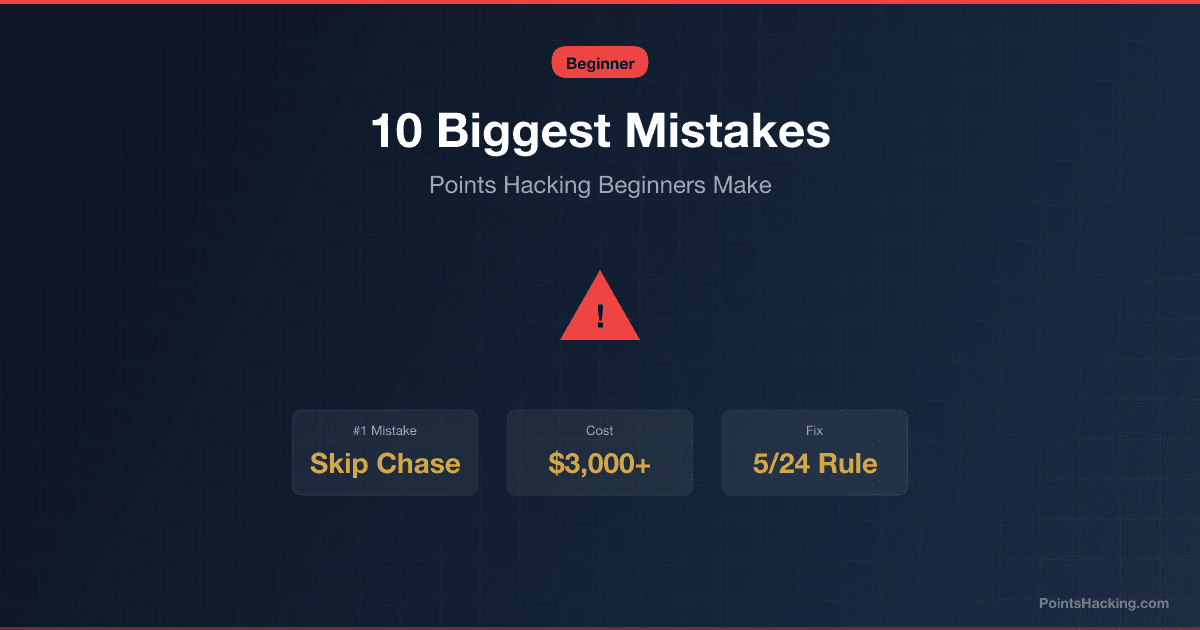
Points hacking is not complicated once you understand the system. But the learning curve has landmines, and beginners hit the same ones over and over. Each mistake below costs real money, sometimes thousands of dollars in lost travel value from a single wrong move.
This guide covers the 10 most common and most expensive beginner mistakes, explains why each one happens, and gives you the exact fix. If you are just getting started, read this before you open your first card or transfer a single point.
For the foundational overview of how the points ecosystem works, start with our beginner's guide to points hacking. This post assumes you have that context and focuses specifically on what goes wrong.
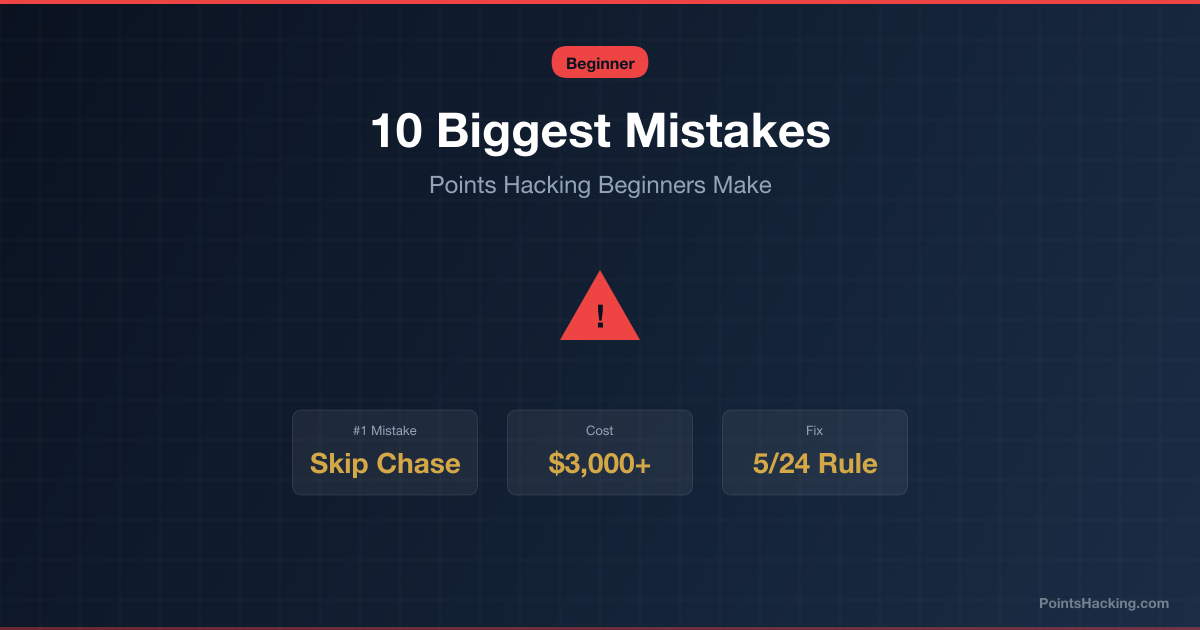
Mistake 1: Not Starting With Chase (The 5/24 Problem)
Chase rejects applicants who have opened 5 or more personal credit cards from any issuer in the past 24 months. This is called the 5/24 rule, and violating it locks you out of the best starter cards in the hobby.
The wrong approach: You hear about the Amex Gold's 4x on restaurants, so you open it first. Then you grab a Capital One Venture X for lounge access. Then a Citi Strata Premier for the 75,000-point bonus. Now you have three new cards, and you still want the Chase Sapphire Preferred and Ink Business Preferred. But if you opened two more personal cards from any bank in the prior 24 months, you are at 5/24 and Chase auto-declines you.
The cost: A Chase Sapphire Preferred bonus of 60,000 UR points is worth $1,230 at 2.05 CPP. The Ink Business Preferred bonus of 100,000 UR points is worth $2,050. Missing both because you opened other cards first means forfeiting $3,280 in travel value. And the 24-month clock does not start until your newest 5/24-counting card, so the lockout can last years.
The fix: Always open Chase personal cards first. Chase business cards (Ink Preferred, Ink Cash, Ink Unlimited) do not count toward 5/24, so you can open those alongside personal cards. Complete your entire Chase wishlist before touching Amex, Citi, Capital One, or Bilt personal cards. For the exact sequence, read our credit card application order strategy.
Mistake 2: Buying Miles Instead of Transferring
Airlines sell miles directly to consumers at 2.5 to 3.5 cents per mile. Those same miles are worth only 1.2 to 1.8 cents in most redemptions. You lose money on the transaction before you even book.
The wrong approach: You see United running a "Buy Miles" promotion offering 100% bonus. You think, "Great, I'll buy 50,000 miles and get 50,000 free." You pay $1,750 for 100,000 miles. Then you redeem those miles for a $1,200 domestic flight. You just paid $1,750 for $1,200 in travel. That is a $550 loss.
The cost: Buying 100,000 United miles costs approximately $3,500 at standard pricing, or $1,750 during a 100% bonus. Transferring 100,000 Chase UR points to United costs $0 in incremental spending because those points came from your normal credit card purchases. The difference: $1,750 to $3,500 per 100,000 miles.
The fix: Never buy miles directly. Earn transferable points from credit card sign-up bonuses and everyday spending, then transfer them 1:1 to the airline when you have confirmed an award booking. Chase, Amex, Citi, Capital One, and Bilt all transfer to airlines at no cost beyond the spending you were already doing. For the complete breakdown of why this works, read Never Buy Points With Your Credit Card.
Mistake 3: Redeeming Points for Statement Credits
Cashing out transferable points as statement credits gives you 1 cent per point (or less). Transferring those same points to airline partners can deliver 5 to 20 cents per point on premium cabin flights.
The wrong approach: You earn 80,000 Chase UR points and redeem them as $800 cash back through the Chase portal. That feels like free money.
The cost: Those 80,000 Chase points transferred to Virgin Atlantic and used for ANA First Class to Tokyo are worth $10,000+ in travel value (12-18 CPP). By cashing out at 1 CPP, you left $9,200 on the table. Even a conservative transfer to United for domestic business class would have yielded 1.5 to 2 CPP, worth $1,200 to $1,600.
The fix: Never redeem transferable currency points (Chase UR, Amex MR, Citi TYP, Capital One Miles, Bilt) as statement credits, gift cards, or cash. Transfer to airline or hotel partners and use them for premium redemptions. If you truly only want cash back, use a dedicated cash back card (Citi Double Cash, Wells Fargo Active Cash) and keep your transferable points for high-value travel bookings. For current point values, see our 2026 points and miles valuations.
Mistake 4: Transferring Points Without Checking Availability First
Credit card point transfers are permanent and irreversible. If you transfer 60,000 Amex MR to Delta and no award seats exist on your route, those points are stuck in Delta's program with no way to reclaim them.
The wrong approach: You decide you want to fly business class to Paris. You transfer 70,000 Amex MR to Air France Flying Blue. Then you search for award space and discover no business class seats are available on any of your travel dates. Now you have 70,000 Flying Blue miles with no booking in sight, and zero Amex MR to show for it.
The cost: 70,000 Amex MR points are worth $1,400 at 2.0 CPP in a good redemption. If those Flying Blue miles sit unused for months or get used on a mediocre economy booking at 0.8 CPP, you extracted $560 instead of $1,400. That is an $840 loss from one rushed transfer.
The fix: Always search for confirmed award availability BEFORE transferring a single point. Use tools like Seats.aero, PointsYeah, or the airline's own website to find a specific flight or room on a specific date. Confirm it is bookable. Then transfer exactly the number of points needed and book immediately. For the full search-then-transfer workflow, see our step-by-step award flight booking guide.
Mistake 5: Ignoring Transfer Bonuses
Transfer bonuses of 25-50% appear multiple times per year on major currencies. Ignoring them means paying full price in points when a discount is available for free.
The wrong approach: You need 80,000 Virgin Atlantic miles for ANA business class to Tokyo. You transfer 80,000 Amex MR to Virgin Atlantic today. Two weeks later, Amex announces a 30% transfer bonus to Virgin Atlantic. If you had waited, you would have needed only 62,000 Amex MR to get the same 80,000 miles.
The cost: 18,000 Amex MR points saved is worth $360 at 2.0 CPP. Over multiple transfers per year, ignoring bonuses can cost $500 to $1,500 annually. That is real money left on the table simply because you did not check the calendar before clicking "transfer."
The fix: Bookmark our transfer bonus tracker and check it before every transfer. Set a calendar reminder to review active bonuses on the first of each month, when many new promotions launch. If you have a trip planned in the next 3 to 6 months, hold your points and watch for a relevant bonus. The patience pays dividends. According to Frequent Miler's tracker, bonuses of 30% or higher appear on most major currencies at least quarterly.
Mistake 6: Carrying a Balance on Rewards Cards
The average credit card APR in 2026 exceeds 22%. Carrying a balance on a rewards card destroys every cent of value the rewards provide and then some. Points hacking only works when you pay in full every month.
The wrong approach: You open a Chase Sapphire Preferred and rush to hit the $4,000 minimum spend for the 60,000-point bonus. You put $4,000 on the card in month one, but you can only pay $2,500 when the statement arrives. You carry $1,500 at 21.49% APR.
The cost: $1,500 carried for 6 months at 21.49% APR costs approximately $161 in interest. Your 60,000-point bonus is worth $1,230 at 2.05 CPP, so you still came out ahead in this case. But carrying $3,000 for 12 months costs $645 in interest, cutting your net value to $585. Carrying a larger balance or carrying it longer can make the entire exercise negative, meaning the rewards card cost you money instead of saving it.
The fix: Never charge more to a rewards card than you can pay in full when the statement arrives. If hitting a minimum spend requirement would stretch your budget, extend the spending over the full three months rather than front-loading it. Set up autopay for the full balance. If you have any tendency to carry a balance, build the pay-in-full habit for at least six months on a no-fee card before applying for rewards cards.
Mistake 7: Opening Too Many Cards Too Fast
Each credit card application creates a hard inquiry on your credit report and reduces your average account age. Opening 5 or more cards in a short window can temporarily drop your score by 30-50 points, trigger fraud alerts, and get applications denied.
The wrong approach: You discover points hacking on a Friday night. By Sunday, you have applied for the Chase Sapphire Preferred, Amex Gold, Capital One Venture X, and Citi Strata Premier. Two applications get denied because of the rapid velocity. Your credit score drops 35 points from four hard inquiries in 48 hours. The banks that denied you now have inquiry records that make future applications harder.
The cost: Two denied applications represent two wasted hard inquiries (each costs 5-10 points on your score) and zero sign-up bonuses. If those denials were for an 80,000-point Amex Gold and a 75,000-point Strata Premier, you missed $2,950 in combined travel value. Plus, some banks flag applicants who have many recent inquiries, making subsequent applications harder for months.
The fix: Space applications at least 30 to 90 days apart. Within a single issuer, wait 90+ days between applications. Across issuers, 30 days is usually safe. Follow a deliberate plan: Chase first (one card every 3 months), then Amex, then Citi, then Capital One. Our application order strategy guide lays out the exact timing and sequence for maximum approval rates.
Mistake 8: Only Looking at One Program
Concentrating all your points in a single program limits your redemption options and exposes you to devaluations. The best points hackers diversify across 2 to 3 transferable currencies to access the widest possible partner network.
The wrong approach: You love Chase, so you only carry Chase cards. You accumulate 200,000 UR points. Then you want to fly Qatar Qsuites to Doha. Chase does not transfer to American Airlines or Qatar Airways. You are stuck booking a less desirable routing or paying cash. Meanwhile, 70,000 Citi ThankYou points transferred to AA would have booked Qsuites at 10+ CPP.
The cost: The opportunity cost depends on the specific redemption you miss, but it is often measured in thousands of dollars. A Qatar Qsuites seat costs $7,000+ in cash. If you cannot access it with your points because you only use one program, you either pay cash, fly a worse product, or skip the trip entirely.
The fix: Build a portfolio across at least two major currencies. The ideal combination for most travelers is Chase UR (for United, Hyatt, Southwest, and Virgin Atlantic) plus either Amex MR (for Delta, ANA, and Cathay Pacific) or Citi TYP (for American Airlines, Turkish, and Qatar). Each program accesses different partners and different sweet spots. Together, they cover virtually every airline and hotel program that matters. See our Chase guide, Amex guide, and Citi guide for full partner breakdowns.
Mistake 9: Not Using Shopping Portals
Airline and credit card shopping portals pay 2 to 15 extra miles per dollar on purchases you were already making at retailers like Nike, Best Buy, Nordstrom, and hundreds more. Skipping them is free money left uncollected.
The wrong approach: You want to buy a $200 pair of running shoes from Nike.com. You go directly to Nike.com and purchase them with your Chase Sapphire Preferred, earning 200 UR points (1x on the purchase). Done.
The cost: If you had clicked through the United MileagePlus Shopping portal first, you would have earned 5 bonus United miles per dollar on top of your credit card earnings. That is 1,000 extra miles on a $200 purchase. Over a year of online shopping, the average household leaves 5,000 to 15,000 bonus miles uncollected. At 1.2 CPP, that is $60 to $180 in free travel value, annually, from doing nothing more than clicking one extra link before each online purchase.
The fix: Before every online purchase, check the shopping portal for the airline or credit card program you are building. The major portals include:
- United MileagePlus Shopping (earns United miles)
- American Airlines AAdvantage eShopping (earns AA miles)
- Chase Ultimate Rewards Shopping (earns UR points)
- Amex Offers (statement credits and bonus MR points)
- Southwest Rapid Rewards Shopping (earns RR points)
- Delta SkyMiles Shopping (earns Delta miles)
Install the browser extension for your primary portal so you never forget. Many portals also stack with credit card category bonuses and coupon codes. For more tools that stack with your credit card strategy, see our best award tools guide.
Mistake 10: Hoarding Points Too Long (Devaluation Risk)
Every major loyalty program has devalued its currency over the past 5 years. Dynamic pricing is spreading. Sweet spots close without warning. Points sitting in your account are losing purchasing power every month.
The wrong approach: You accumulate 500,000 Chase UR points over three years, waiting for "the perfect trip." Meanwhile, United raises award prices, Hyatt adds dynamic pricing tiers, and Virgin Atlantic adjusts its ANA First Class chart. The redemptions you could have booked at 72,500 miles now cost 95,000 miles. Your 500,000 points buy less today than 350,000 would have bought two years ago.
The cost: Devaluation rates vary by program, but the trend is consistent: airline and hotel award prices increase 5 to 15% per year on average across programs. 500,000 UR points worth $10,250 at 2.05 CPP today might be worth $8,700 in two years if valuations drop even 8%. That is $1,550 evaporated by waiting.
The fix: Adopt an "earn and burn" mentality. Set a target trip before you start earning. Earn the points for that trip. Transfer and book within 12 to 24 months of earning. Then set the next target. Holding a small buffer of 50,000 to 100,000 transferable points for opportunistic bookings is fine. Stockpiling 500,000+ points with no plan is asking for devaluation losses. For the latest on which programs are devaluing fastest and how to protect yourself, read our 2026 points and miles valuations guide.
The Bottom Line: Build the Right Habits Early
Every mistake on this list is avoidable. Not one requires advanced knowledge or specialized tools. They all come from the same root cause: acting before understanding the system.
Here is the cheat sheet:
- Chase first. Always. No exceptions until your Chase wishlist is complete.
- Transfer, do not buy. Transferring credit card points is always better than buying miles.
- Never cash out transferable points. Use a separate cash back card if you want cash.
- Search, then transfer. Confirm availability before moving a single point.
- Check transfer bonuses weekly. Free extra miles require only a calendar reminder.
- Pay in full every month. Interest destroys rewards. Autopay the full balance.
- Space applications 30-90 days apart. Velocity kills approval odds.
- Use at least two programs. Chase plus Amex or Citi covers nearly every partner.
- Use shopping portals. One extra click earns thousands of free miles per year.
- Earn and burn within 12-24 months. Devaluation punishes hoarders.
If you follow these ten rules from day one, you will avoid the mistakes that cost most beginners $5,000 to $10,000 in their first year. More importantly, you will build the habits that compound over decades of free travel.
Ready to start? Open our beginner's guide, pick your first card from our best travel cards list, and follow the application order strategy. The system works. You just have to play it correctly from the beginning.