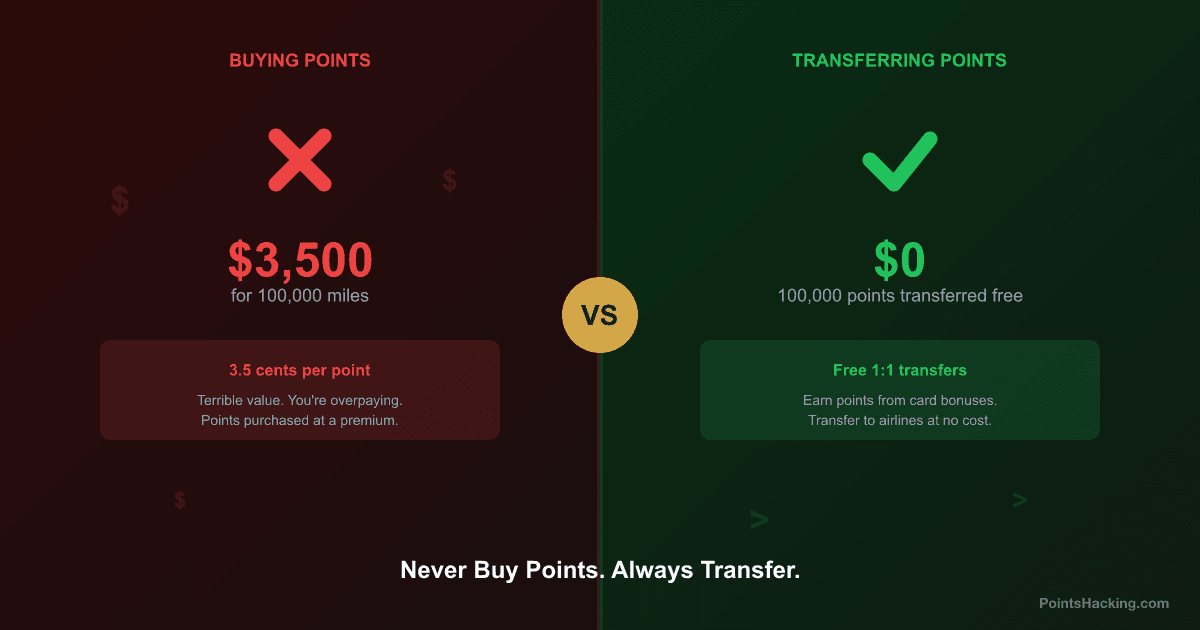
Here is the single most important rule in points hacking: never buy airline miles or hotel points directly with cash. Always transfer from your credit card program.
This is the move that separates beginners from tacticians. It is also the most commonly violated rule in the hobby, often because airlines run "Buy Miles" promotions that look attractive on the surface. The math, when you run it honestly, almost never works in your favor. And when you understand the alternative — transferring credit card points you earned for free — buying miles becomes almost impossible to justify.
Let's break down exactly why this rule exists and how to apply it.
Why Buying Miles Destroys Value
Airlines sell miles directly to consumers at prices that seem designed to look like a deal but rarely are. United MileagePlus charges approximately 3.5 cents per mile. Delta SkyMiles runs 2.5–3.5 cents per SkyMile. Marriott Bonvoy sells points at roughly 1.25 cents each. American Airlines AAdvantage charges about 3.5 cents per mile during standard pricing, occasionally dropping to 2.5 cents during promotional windows.
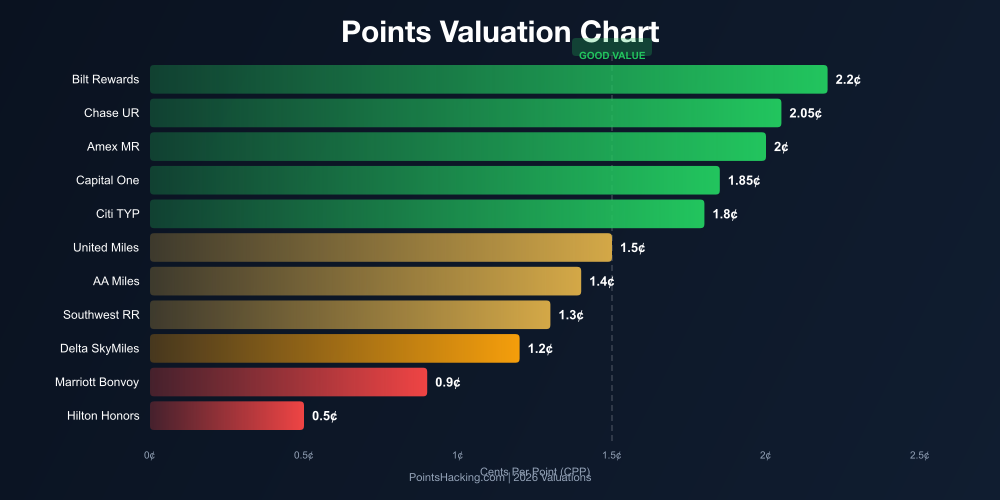
The problem is stark: those same miles are worth only 1.2–1.8 cents each in most redemptions. If you buy 100,000 United miles for $3,500 and redeem them for a flight worth $1,800 in cash, you've lost $1,700. That's not a deal — it's a reverse discount.
Even when airlines advertise a "50% bonus" on purchased miles, the math rarely works. A 50% bonus on United miles brings the effective cost from 3.5 cents to about 2.3 cents per mile. You'd still need to extract 2.3+ cents per point in your redemption to break even — and most domestic economy redemptions deliver less than that.
Meanwhile, transferable credit card points cost you nothing beyond your normal spending. When you earn 4x Amex Membership Rewards at restaurants, those points are free — you were going to eat dinner anyway. When you earn 3x Chase Ultimate Rewards on travel, you were booking that flight regardless. And when you transfer those points to an airline partner, they're worth the exact same amount as purchased miles — but they cost you nothing extra.
The Transfer Math With Real Examples
Let's run three side-by-side comparisons — domestic economy, international business, and hotel — to show exactly how the math plays out.
Example 1: Domestic Economy (New York to Los Angeles)
Cash price: $350 round-trip. United MileagePlus price: 25,000 miles round-trip.
Buying option: 25,000 United miles at 3.5 cents each = $875 cost. You spend $875 to get a $350 flight. That's a 0.4x return — you lose money.
Transfer option: 25,000 Chase Ultimate Rewards points transferred 1:1 to United. Those points were earned from normal spending. Cost: $0 incremental. You get a $350 flight for free.
Example 2: International Business Class (New York to London)
Cash price: $4,500 one-way in business class. Virgin Atlantic Flying Club price: 50,000 miles one-way on Delta One.
Buying option: 50,000 Virgin Atlantic miles at roughly 2.8 cents each (best promotional price) = $1,400. You spend $1,400 for a $4,500 seat. That's a 3.2x return — actually decent, but only during aggressive promotions.
Transfer option: 50,000 Amex Membership Rewards points transferred 1:1 to Virgin Atlantic. Cost: $0 incremental. You get a $4,500 business class seat for free. That's an infinite return on zero incremental cost.
Example 3: Hotel (Park Hyatt New York)
Cash price: $900 per night. World of Hyatt price: 35,000 points per night (peak pricing).
Buying option: Hyatt doesn't sell points directly, but Marriott does at 1.25 cents each. For comparison, 35,000 Marriott points would cost $437.50 to buy. Marriott points are worth far less than Hyatt points, so this comparison illustrates why hotel currencies aren't interchangeable.
Transfer option: 35,000 Chase Ultimate Rewards points transferred 1:1 to World of Hyatt. Cost: $0 incremental. You get a $900 hotel night for free — 2.57 cents per point in value.
The pattern is consistent across every example: transferred points deliver free or near-free travel. Purchased miles deliver discounted travel at best. For more on how Chase Ultimate Rewards fits into this strategy, read our Chase Ultimate Rewards complete guide.
The 5 Major Transferable Currencies
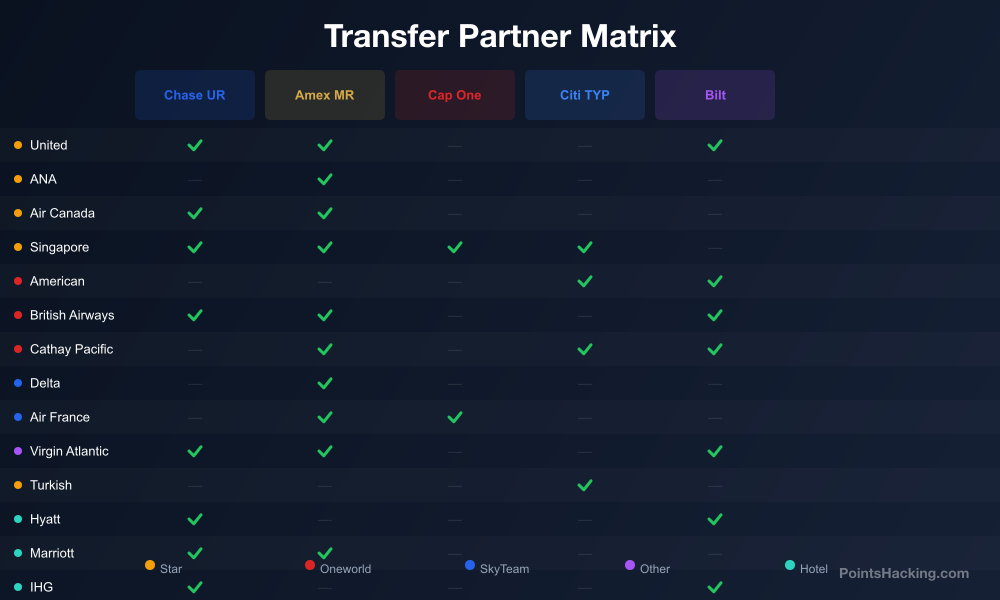
Understanding which currencies exist and what they connect to is the foundation of the transfer strategy. Here are the five major transferable point programs in 2026, ranked by partner network depth and redemption flexibility.
1. Chase Ultimate Rewards (UR)
14 transfer partners including United MileagePlus, World of Hyatt, British Airways Avios, Air Canada Aeroplan, Air France/KLM Flying Blue, Singapore KrisFlyer, Virgin Atlantic Flying Club, Southwest Rapid Rewards, JetBlue TrueBlue, Iberia Avios, Aer Lingus Avios, IHG One Rewards, Marriott Bonvoy, and Wyndham Rewards. All transfers are 1:1 and most are instant. Chase UR is the best single currency for accessing World of Hyatt — the most valuable hotel program — without a Hyatt co-branded card.
2. Amex Membership Rewards (MR)
20+ transfer partners including Delta SkyMiles, Air France Flying Blue, ANA Mileage Club, Avianca LifeMiles, British Airways Avios, Cathay Pacific Asia Miles, Emirates Skywards, Etihad Guest, Iberia Avios, Japan Airlines Mileage Bank, Singapore KrisFlyer, Virgin Atlantic Flying Club, Hilton Honors (1:2), Marriott Bonvoy, and Choice Privileges. Amex MR is the best currency for accessing ANA, Cathay Pacific, and Avianca LifeMiles, which unlock some of the most valuable sweet spots in the hobby.
3. Capital One Miles
17+ transfer partners including Turkish Airlines Miles&Smiles, Air France/KLM Flying Blue, Avianca LifeMiles, Singapore KrisFlyer, Air Canada Aeroplan, British Airways Avios, Emirates Skywards, EVA Air Infinity MileageLands, and Wyndham Rewards. Capital One is unique in offering Turkish Airlines as a transfer partner — Turkish has one of the most generous award charts for Star Alliance business class, including United Polaris seats that United's own program prices significantly higher.
4. Citi ThankYou Points (TYP)
16+ partners including American Airlines AAdvantage (re-added July 2025), Turkish Airlines Miles&Smiles, Air France/KLM Flying Blue, Singapore KrisFlyer, Avianca LifeMiles, Cathay Pacific Asia Miles, EVA Air, Japan Airlines, Qatar Privilege Club, and Choice Privileges (1:2 favorable). The American Airlines partnership makes Citi TYP the only $95 annual fee path to AA miles via transfer — critical for accessing Qatar Qsuites, Cathay Pacific business class, and JAL First through the Oneworld chart.
5. Bilt Rewards
20+ partners including Alaska Airlines Mileage Plan (exclusive — no other transferable currency transfers to Alaska), World of Hyatt (1:1), United MileagePlus, Emirates Skywards, Air Canada Aeroplan, Singapore KrisFlyer, Japan Airlines, and IHG One Rewards. Bilt's exclusive Alaska Airlines partnership is uniquely valuable: Alaska has the most generous award chart for first class on American Airlines metal, and Alaska miles can book Emirates First Class at incredibly low prices. No other credit card currency provides access to these redemptions.
Transfer Bonuses: Free Extra Miles on Top of Free Miles
On top of the base advantage of transferred points over purchased miles, banks periodically offer transfer bonuses — promotional multipliers that increase the number of miles you receive when you move points from your credit card program to a partner.
A 25% transfer bonus from Chase to Marriott means that 60,000 Chase UR points become 75,000 Marriott Bonvoy points. A 40% bonus from Amex to Virgin Atlantic means 50,000 Amex MR becomes 70,000 Virgin Atlantic miles — enough for ANA First Class to Tokyo, which would otherwise require 85,000 miles. A 30% bonus from Capital One to Turkish means 50,000 Capital One miles becomes 65,000 Turkish miles.
These bonuses are entirely free. You earn the same points from your normal spending; you just time your transfer to coincide with an active bonus.
The savings are real: if you need 80,000 Virgin Atlantic miles and a 25% bonus is active, you transfer 64,000 Amex MR instead of 80,000 — saving 16,000 points worth $320–$500 in future value.
The strategic play: hold your points in flexible currencies until you have a specific redemption confirmed AND a relevant transfer bonus aligns. This requires patience, but the upside is meaningful. According to Frequent Miler's transfer bonus tracker, transfer bonuses of 30–50% appear multiple times per year across the major currencies, with predictable partners rotating through promotions seasonally.
Use our live transfer bonus tracker to see current promotions before you move any points. Bonuses are time-limited and sometimes only appear for 24–48 hours, so having a bookmark and a notification system is worth setting up.
The 5 Rules of Smart Transfers
Following these rules prevents the most common and costly transfer mistakes.
Rule 1: Never transfer speculatively. Confirm award availability BEFORE initiating any transfer. Call the airline's award booking line or use an award search tool to find and hold the specific seat or room you want. Then transfer points. Transfers are irreversible — once points leave your Chase or Amex account, they cannot be returned. A speculative transfer to Delta SkyMiles for a route where no award space exists is a permanent loss.
Rule 2: Track transfer bonuses actively. Frequent Miler, AwardWallet, and our own tracker maintain live lists of all current transfer promotions. Check these weekly. Set calendar reminders to look on the first of each month, when many new promotions activate. The difference between a 0% and 30% bonus on a transfer is meaningful — it can cut your required balance by 23%.
Rule 3: Know your partner's award rules before transferring. Some programs charge fuel surcharges on partner awards (British Airways Avios charges them on non-BA partner flights; Flying Blue does not). Some programs have close-in booking fees (United charges $75 for awards within 21 days). Some require the cardholder to be a program member for a set period before redeeming. Know these rules in advance so you don't lose points to surprise fees.
Rule 4: Keep a points vault card in each ecosystem. Maintain at least one no-annual-fee card that earns each major currency. The Chase Freedom Unlimited ($0) keeps your Chase UR account alive and earning without a fee. The Amex Blue Business Plus ($0) keeps your Amex MR account active. If you cancel your only Chase Sapphire card, your UR points expire immediately unless you have another UR-earning card. The vault card prevents this.
Rule 5: When historical high bonuses appear, act fast if you have a trip planned. Virgin Atlantic to Amex historically tops out around 40%. Turkish Airlines to Capital One has hit 50%. These high-water marks don't appear often. When they do, and you have a confirmed redemption in mind, moving points at the bonus rate accelerates your timeline significantly. Don't move points just because a bonus exists — but if the timing aligns with a trip you're already planning, there's no reason to leave free miles on the table.
For context on how these strategies fit within specific programs, read our Amex Membership Rewards complete guide, which covers all 20+ Amex transfer partners and their individual sweet spots.