
Chase Ultimate Rewards is the most versatile points currency in the hobby. Fourteen transfer partners, instant transfers on almost every route, and the deepest card ecosystem of any major issuer. When points hackers say "start with Chase," this is why.
This guide covers everything: the full partner list with transfer ratios and timing, the five best redemption sweet spots with complete math, how the card ecosystem pools together, the 5/24 rule and how to work around it, and the decision framework for when to transfer versus when to hold.
If you're new to points hacking and haven't read our beginner's guide to points hacking, start there first. This guide assumes you understand the basics of how transferable points currencies work.
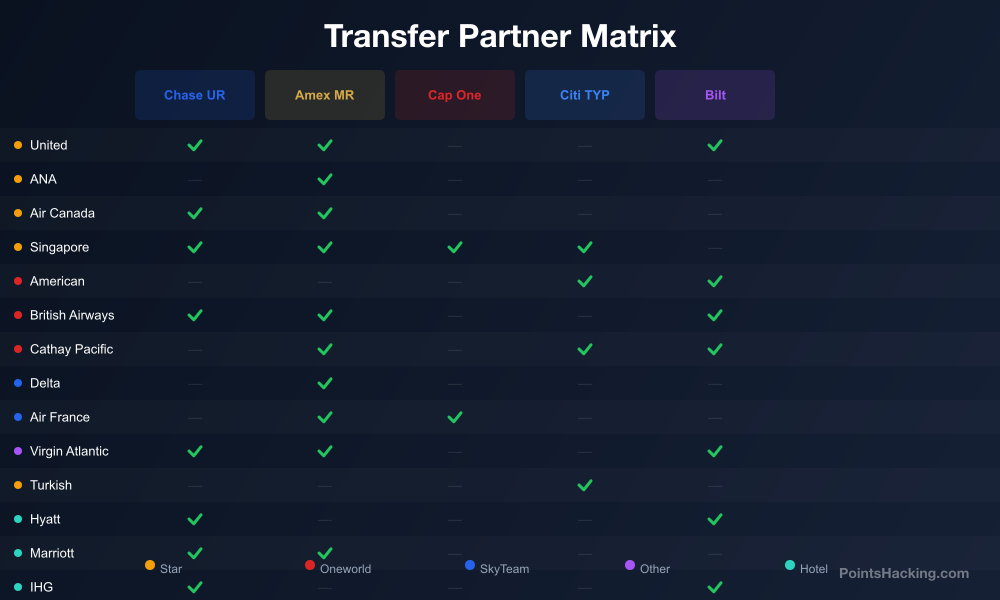
All 14 Chase Transfer Partners (1:1 Ratio)
Every Chase Ultimate Rewards transfer is at a 1:1 ratio — 1,000 Chase points becomes 1,000 airline miles or hotel points. There are no unfavorable conversion rates, unlike some competing programs. Here is the complete list as of March 2026.
Airline Partners (10):
- Aer Lingus AerClub (Avios) — Part of the Avios family. Useful for short-haul European flights and transatlantic Aer Lingus routes, though best Avios redemptions come through British Airways or Iberia.
- Air Canada Aeroplan — One of the most valuable partners. Books Star Alliance flights (United Polaris, Lufthansa, Swiss, ANA, Singapore Airlines) without fuel surcharges, at competitive prices with stopover rules that let you see two cities for the price of one award.
- Air France/KLM Flying Blue — Runs monthly Promo Rewards sales discounting partner routes 25–50%. Best program for transatlantic economy and business during sale periods. Also books Delta One flights in the U.S.
- British Airways Executive Club (Avios) — Best for short-haul domestic flights on American Airlines metal (7,500 Avios one-way under 650 miles) and Oneworld transatlantic in business. Fuel surcharges apply on BA-operated flights; partner flights generally avoid them.
- Iberia Plus (Avios) — Often prices transatlantic routes in business class cheaper than British Airways, without surcharges. The best Avios currency for Madrid-based routes and sometimes cheaper transatlantic business overall.
- JetBlue TrueBlue — Revenue-based program, not zone-based. Redemption value is consistent but modest (1.4–1.5 CPP typically). Best for JetBlue Mint (business class) on transcontinental routes that aren't otherwise served by premium cabins through partner programs.
- Singapore Airlines KrisFlyer — Books Singapore Suites (first class) and Singapore Business Class, including the acclaimed A380 Suite product. Transfer takes 24–48 hours. The Singapore Suites sweet spot (the most famous product in aviation) is 85,000 KrisFlyer miles one-way in Suites from the U.S. West Coast. Cash price: $15,000+.
- Southwest Airlines Rapid Rewards — Revenue-based. Best value if you can get the Southwest Companion Pass, which lets a designated companion fly free on every flight for up to two calendar years. Requires earning 135,000 Rapid Rewards points in a calendar year.
- United Airlines MileagePlus — Chase's flagship airline partner. Books Star Alliance flights at straightforward prices, including United Polaris business class and United First. No fuel surcharges on partner awards. Best for domestic routes and specific international routes where United pricing beats Aeroplan.
- Virgin Atlantic Flying Club — The single most important Chase transfer partner for aspirational first class redemptions. Books ANA "The Room" and "The Suite" first class products on transpacific routes at prices that no other program matches. Also books Delta One and Air France La Première at competitive rates.
Hotel Partners (4):
- World of Hyatt — The best hotel program in the business. Points consistently deliver 1.7–2.5 CPP, making Chase-to-Hyatt one of the most reliable and highest-value transfers available anywhere. All-inclusive resorts in Mexico and the Caribbean are the standout category.
- IHG One Rewards — Generally lower value than Hyatt but useful for specific properties. IHG runs 4th-night-free promotions on awards. Value varies widely by property and date.
- Marriott Bonvoy — Largest hotel footprint in the world. Points are worth roughly 0.7–0.9 cents each, making this the weakest hotel transfer on a per-point basis. Worth considering for Marriott Category 1–4 properties where cash rates are elevated relative to points prices.
- Wyndham Rewards — Most useful for Wyndham timeshare properties (which allow point redemptions) and a handful of aspirational properties. Low average value but occasionally useful for specific situations.
Top 5 Chase UR Sweet Spots (With Full Math)
Not all 14 partners deliver equal value. These five redemption pathways represent the highest-value uses of Chase Ultimate Rewards points available today.
Sweet Spot 1: Virgin Atlantic → ANA First Class "The Suite" or "The Room"
Points required: 72,500–85,000 Virgin Atlantic miles one-way from the U.S. to Japan.
Cash price equivalent: $10,000–$16,000 for ANA First Class "The Suite" (the newer product) from New York or Los Angeles to Tokyo.
Cents per point: 12–22 CPP.
This is the most famous and highest-value redemption in the Chase ecosystem. Transfer Chase UR to Virgin Atlantic at 1:1, then call Virgin Atlantic to book ANA-operated flights on the JL/NH Star Alliance-adjacent routes. The Suite is ANA's private suite product — double beds, sliding doors, personal storage. Cash fares on the same route exceed $12,000. At 72,500 Virgin Atlantic miles, you're extracting over 16 CPP. No other mainstream transfer delivers this consistently.
Sweet Spot 2: World of Hyatt All-Inclusive Resorts
Points required: 15,000–25,000 Hyatt points per night (Category 4–6).
Cash price equivalent: $400–$900+ per night including food, drinks, and activities.
Cents per point: 2.5–5+ CPP on all-inclusives (food and drink multiplier).
Hyatt's all-inclusive collection — Ziva (family) and Zilara (adults-only) resorts in Mexico and the Caribbean — is the single best category in hotel points hacking. Points cover room, all meals, all drinks, and most activities. When cash rates run $600/night and you're redeeming 20,000 points, you're extracting 3 CPP just on room value, plus a full food and beverage credit that adds another 1–2 CPP equivalent. Stack the 5th Night Free benefit (book 5 consecutive award nights, pay for only 4) and the math gets even better.
Sweet Spot 3: Air Canada Aeroplan for Star Alliance Business Class
Points required: 55,000–75,000 Aeroplan points for short or medium-haul Star Alliance business, 70,000–90,000 for transpacific.
Cash price equivalent: $2,500–$8,000 for business class to Europe or Asia on United Polaris, Lufthansa, Swiss, or ANA.
Cents per point: 3–8 CPP depending on route and cabin.
Aeroplan books Star Alliance partners without fuel surcharges and with stopover privileges that allow you to add a free destination. A round-trip Lufthansa business class itinerary from New York to Europe with a free stopover in one country can be booked for 70,000 Aeroplan points — a ticket that costs $5,000+ in cash. Aeroplan is also one of the few programs that allows mixing and matching Star Alliance carriers on a single itinerary.
Sweet Spot 4: British Airways Avios for Short-Haul American Airlines Flights
Points required: 7,500 Avios one-way for American Airlines flights under 650 miles. 15,000 Avios round-trip.
Cash price equivalent: $200–$400 for the same routes booked through AA directly.
Cents per point: 1.5–3 CPP for domestic short-haul.
British Airways charges a distance-based award chart for partner bookings. Flights under 650 miles cost 7,500 Avios one-way on American Airlines with no fuel surcharge. This covers routes like New York to Boston, Chicago to St. Louis, Dallas to Houston, Los Angeles to Las Vegas — markets where last-minute cash prices spike but award availability is generally good. Transfer Chase UR to British Airways and book directly through the BA website using the AA metal filter.
Sweet Spot 5: Southwest Companion Pass
Points required: 135,000 Rapid Rewards points earned in one calendar year to qualify, then the Companion Pass is free for the remainder of that year plus the entire following year.
Value: Free airfare for a designated companion on every flight for up to 2 years.
Effective CPP: Unlimited — companion flies free on all flights, including award flights.
The Southwest Companion Pass is the single highest-leverage benefit in domestic travel. Once earned, a designated companion flies free on every Southwest flight you take — including award flights, which means two free seats for the price of one. Transfer Chase UR to Southwest and combine with the Southwest credit card sign-up bonuses (each delivers 60,000–80,000 Rapid Rewards points toward the 135,000 requirement) for the most efficient path to the Companion Pass.
The Chase Card Ecosystem: How All Cards Pool Together
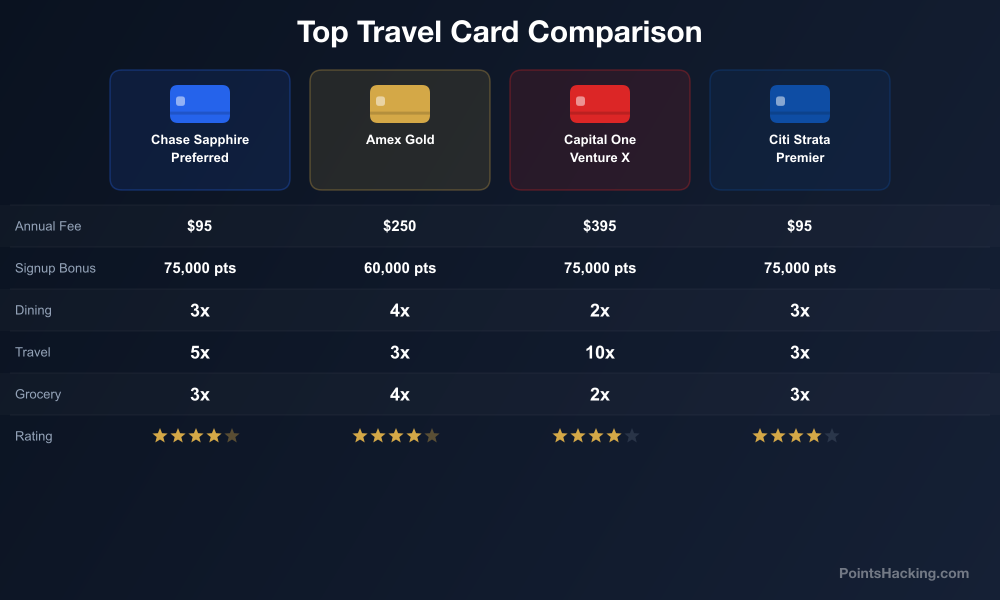
Chase Ultimate Rewards works as a pooled currency across multiple cards in your account. No-annual-fee Freedom cards earn UR points, but those points cannot be transferred to partners until you hold a Sapphire or Ink Preferred card on your account. Here is the full card lineup.
Chase Sapphire Preferred ($95/year) — 5x on Chase Travel, 3x on dining, streaming, and online grocery, 2x on all other travel. The entry-level card that unlocks UR transfers. The best starter card for most people entering the Chase ecosystem. Current sign-up bonus: 60,000+ UR points after $4,000 spend in 3 months.
Chase Sapphire Reserve ($795/year) — 8x on Chase Travel, 4x on direct flights and hotel purchases, 3x on dining. $300 travel credit that auto-applies to any travel purchase. Priority Pass lounge access. 1.5x multiplier when redeeming UR through the Chase portal (worth 1.5 cents per point). The higher annual fee is justified only if you spend heavily on travel and regularly use Priority Pass. After the $300 credit, effective fee is $495.
Chase Freedom Unlimited ($0/year) — 1.5x on everything. The catch-all no-fee earner that fills gap categories. Pairs perfectly with the Sapphire Preferred: use Freedom Unlimited for 1.5x on non-bonus spending, transfer points to Sapphire to access transfer partners.
Chase Freedom Flex ($0/year) — 5x on rotating quarterly categories (gas stations, grocery stores, streaming services, etc., up to $1,500/quarter). 3x on dining and drugstores. A strong category optimizer when the quarterly bonus aligns with your spending.
Chase Ink Business Preferred ($95/year) — 3x on first $150,000 in travel, shipping, internet services, cable, phone, and advertising. The best business card in the Chase ecosystem for high-volume business spenders. Earns UR points that pool with personal cards.
Chase Ink Business Cash ($0/year) and Ink Business Unlimited ($0/year) — No-fee business cards that earn UR points. Note: as of November 2025, Chase has made prior holders of any no-fee Ink card ineligible for additional no-fee Ink sign-up bonuses.
All cards pool together into a single UR balance accessible for transfers when you hold a Sapphire or Ink Preferred. Build the ecosystem strategically: Sapphire Preferred first, then no-fee cards for category coverage.
The 5/24 Rule: Why Chase Must Come First
The 5/24 rule is the most important single constraint in the entire points hacking hobby.
The 5/24 rule is the most important single constraint in the entire points hacking hobby. Chase automatically declines any application from someone who has opened five or more personal credit cards from any issuer in the past 24 months. The rule applies across all banks — a Capital One card, an Amex card, and a Citi card all count against your Chase 5/24 status equally.
This means: if you open an Amex Gold and a Capital One Venture before getting your first Chase card, you have burned two of your five available 5/24 slots. Those slots don't reset for 24 months from the date of each card opening. Every non-Chase personal card you open before your Chase cards is a permanent opportunity cost.
Business cards are the exception. Business cards from Chase, Amex, Citi, Barclays, Bank of America, US Bank, and Wells Fargo do NOT count toward 5/24. You can open six Amex business cards and still be at 0/24 in Chase's eyes (you still need to be under 5/24 to get approved for Chase business cards, but business cards themselves don't add to your count). Capital One business cards DO count — except the Venture X Business and Spark Cash Plus.
The optimal strategy: get Chase cards first. Sapphire Preferred at month 0. Freedom Unlimited at month 3–4. Freedom Flex at month 6–7. Ink Business Preferred at month 9–12. After building out the Chase ecosystem, open business cards from other issuers (Amex, Citi) that don't count toward 5/24, then eventually personal cards from non-Chase issuers when your Chase portfolio is complete or when you're willing to sacrifice 5/24 slots for a specific sign-up bonus.
For a detailed application order strategy across all major issuers, read our guide on the best travel credit cards of 2026.
When to Transfer vs. When to Hold
Holding transferable points in your Chase account keeps them flexible — you can send them to any of the 14 partners at the moment you find the right redemption. Transferring locks them into a specific program where they may be worth less if your plans change. The decision framework is straightforward.
Always hold until you have confirmed award availability. Never transfer points because you're thinking about a trip. Transfer only when you have found a specific seat or room, confirmed it's available for the dates you want, and verified that the points requirement is favorable. Award space disappears. A transfer to a program where no space exists is a permanent loss of flexibility.
Transfer to Hyatt aggressively. World of Hyatt is the one exception to the "hold until confirmed" rule, because Hyatt points reliably deliver 1.8+ CPP across a wide range of properties. If you have more Chase UR than you need in the medium term, transferring to Hyatt and building a Hyatt balance for future travel is defensible. Hyatt points are among the most reliably valuable hotel points in existence.
Watch for transfer bonuses before moving points. Chase periodically runs promotional transfer bonuses to specific partners. A 25–30% bonus to Marriott or IHG is rarely worth triggering, because those programs deliver low base value. But if a 20%+ bonus appears to United, Aeroplan, Virgin Atlantic, or Flying Blue and you have a trip planned, transferring at the bonus rate meaningfully reduces the points required.
Never transfer to cash or gift cards. Chase allows you to redeem UR at 1 cent per point for statement credits or gift cards. This is always the worst option.
Even through the Chase Travel portal at 1.25–1.5 cents per point (depending on your card), you're leaving significant value on the table compared to transfer partner redemptions. The only reason to cash out UR is in an emergency where you have no better option and you genuinely need the cash.
According to AwardWallet, which tracks points balances and expiration across hundreds of loyalty programs, the most common points-related mistake is transferring to a program speculatively and then being unable to find the award seat they originally wanted. Patience — holding until confirmed, then transferring immediately — is the single most important discipline in transfer partner strategy.
For the full picture on Amex Membership Rewards, which pairs with Chase UR to give you access to nearly every major airline and hotel program simultaneously, read our Hyatt redemptions under 25,000 points guide — the strongest Chase UR hotel transfer partner in detail.