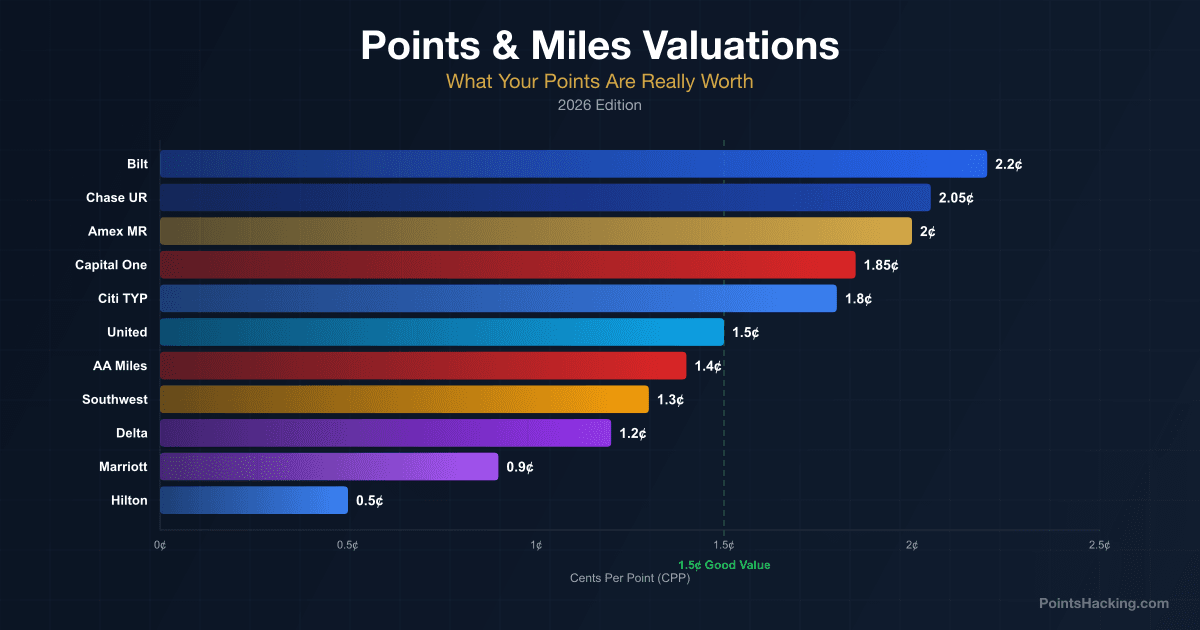
One of the most important — and most misunderstood — concepts in travel rewards is the idea that points have a fixed value. They do not. A Chase Ultimate Rewards point is not inherently worth 2.05 cents. That is an average across the many ways you can redeem those points. Some redemptions yield 5 cents per point; others yield less than 1 cent. Understanding how to calculate and apply point valuations is the foundation of extracting real value from any rewards program.
This guide covers what cents per point (CPP) means, how to calculate it for any specific redemption, and the 2026 valuations for every major airline and hotel currency. We also cover the macro trend of devaluation and how to think about whether to redeem points now or hold them.
For the best ways to earn the currencies covered here, start with our Chase Ultimate Rewards complete guide and our Amex Membership Rewards complete guide — together they cover the two most versatile transferable currencies available to US cardholders.
What Is Cents Per Point (CPP)?
Cents per point, abbreviated CPP, is the standard unit for measuring how much value you are extracting from a points redemption. It answers the question: "If I used these points instead of paying cash, how much did each point save me?"
The formula: CPP = (Cash Price / Points Required) x 100
Example: You want to book a hotel room. The cash price is $300 per night. The points cost is 20,000 points. CPP = (300 / 20,000) x 100 = 1.5 cents per point. If your points currency is valued at 1.7 CPP (Hyatt), this is a slightly below-average redemption. If your currency is Marriott Bonvoy at 0.8 CPP, this is an excellent redemption.
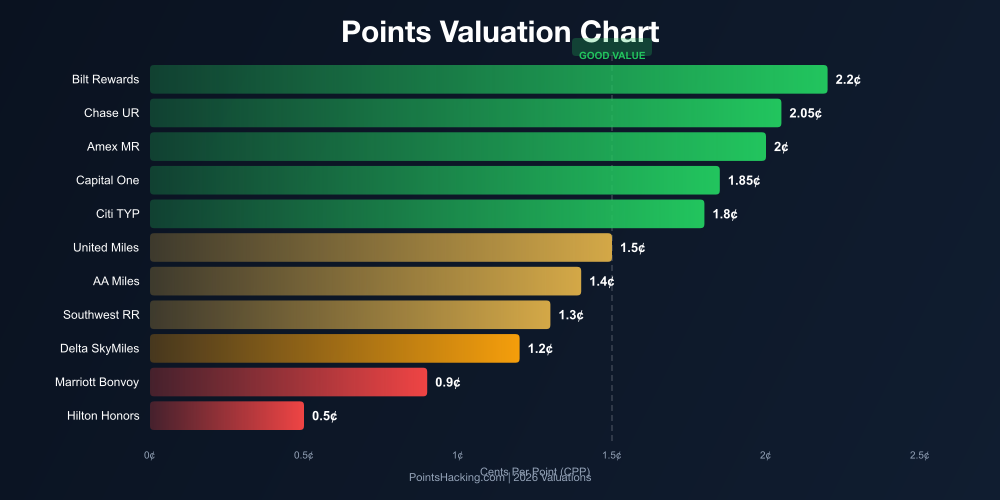
For flights, the same logic applies: if a business class seat costs $4,000 in cash and requires 80,000 miles, that is (4,000 / 80,000) x 100 = 5.0 CPP — an exceptional redemption for virtually any mileage currency. If that same seat costs 160,000 miles, that is 2.5 CPP — still likely above most airline valuations but less exciting.
CPP is not a static number for a given program — it is a range that depends entirely on how you redeem. That is why average valuations exist: they represent a reasonable benchmark for what a well-informed redeemer can typically achieve across the most common redemption types in each program.
Transferable Currency Valuations 2026
Transferable currencies — points earned from bank credit cards that can be sent to multiple airline and hotel partners — are the most valuable points in the ecosystem because of their flexibility. Here are the 2026 valuations for each major transferable currency:
Chase Ultimate Rewards: 2.05 CPP
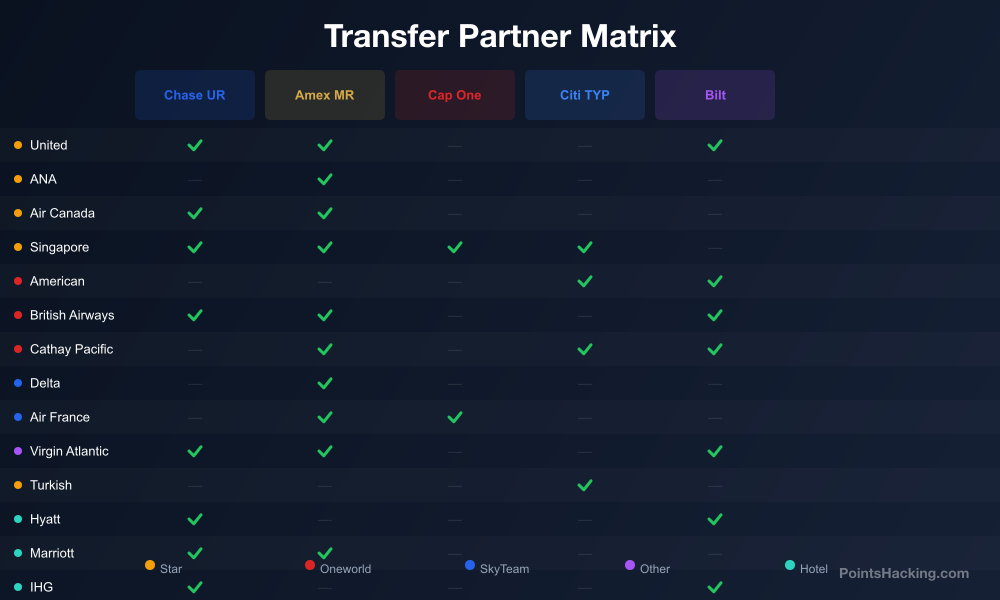
The most widely used transferable currency for US travelers. Transfers at 1:1 to United, Southwest, Hyatt, British Airways, Air France/KLM, Singapore Airlines, and more. The 2.05 CPP average reflects the strong value available through United and Hyatt transfers. Chase UR points can also be redeemed at 1.25-1.5 cents each through the Chase Travel portal — a good floor value when transfer partners do not offer better options.
Bilt Rewards: 2.2 CPP
Bilt earns the highest average valuation of any transferable currency in 2026 despite being the newest major player. Bilt transfers to the same partners as Chase (United, Hyatt, American, British Airways, and others) plus additional partners including Air France, Turkish Airlines, and Emirates. The premium valuation reflects Bilt's unique airline and hotel partner mix, which enables some of the best redemption opportunities available. The Bilt Mastercard earns points on rent with no transaction fee — the only card that does so — making it effectively free points for the largest household expense most people have.
American Express Membership Rewards: 2.0 CPP
Amex MR transfers to Air France/KLM Flying Blue, Delta SkyMiles, British Airways Avios, Singapore Airlines KrisFlyer, ANA Mileage Club, Emirates Skywards, Avianca LifeMiles, and more. The strong international partner mix drives the 2.0 CPP average — particularly Flying Blue, which regularly runs transfer bonuses and offers excellent business class availability on Air France and KLM. See our Amex Membership Rewards guide for full partner details.
Capital One Miles: 1.85 CPP
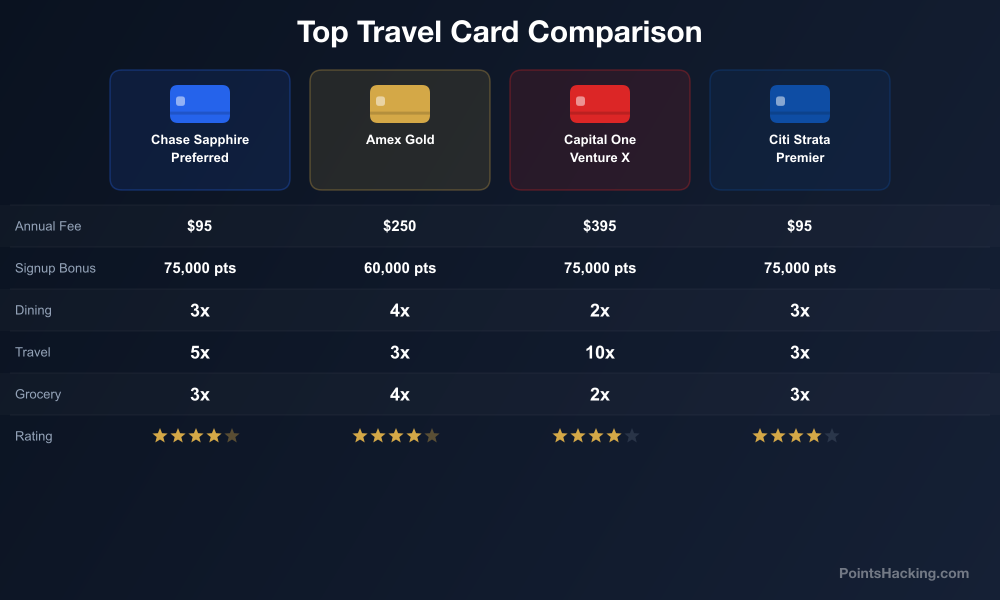
Capital One's transfer ecosystem has expanded significantly in recent years and now includes Air France/KLM, Turkish Airlines, Avianca, Singapore Airlines, British Airways, and others. The 1.85 CPP average places Capital One firmly in the second tier of transferable currencies. The Venture X card, which earns 2x miles on everything and 10x on hotels and rental cars through Capital One Travel, is a strong option for simplicity-oriented travelers.
Citi ThankYou Points: 1.8 CPP
Citi's transfer network includes Avianca LifeMiles, Turkish Airlines Miles&Smiles, Cathay Pacific Asia Miles, Air France/KLM Flying Blue, Singapore Airlines, and others. The 1.8 CPP average is solid, though Citi lacks the domestic-focused partners (United, Southwest, Hyatt) that drive Chase's higher valuation. Citi's strengths lie in international premium cabin redemptions through Avianca and Turkish.
Airline Mile Valuations 2026
Airline miles are less flexible than transferable currencies — they can only be redeemed on flights and a handful of partners. But when used strategically, they can deliver the highest per-point value in the entire ecosystem.
American Airlines AAdvantage: 1.4 CPP
AAdvantage is one of the stronger airline programs in 2026 thanks to a large partner network and relatively stable award pricing on partner carriers. The best AAdvantage redemptions are on Japan Airlines (JAL) business class to Asia, British Airways on short-haul routes in Europe (using Avios-equivalent pricing), and Cathay Pacific first class using AA miles — one of the last accessible first class deals in the miles world. Domestic AA saver awards have been devalued, so focus on international partners for best value.
United MileagePlus: 1.2 CPP
United's dynamic pricing model (implemented in 2019) makes finding consistently good value harder than programs with fixed charts. The 1.2 CPP average reflects a mix of strong redemptions (Lufthansa first class, ANA business class via partner awards) and poor ones (domestic routes where cash prices are low). United miles shine most on Star Alliance partners — particularly ANA, Lufthansa, and Singapore Airlines — where business and first class availability can be exceptional at reasonable mile costs.
Delta SkyMiles: 1.2 CPP
Delta SkyMiles has the most dynamic — and most opaque — pricing of any major US airline program. Delta removed its award chart entirely in 2015, and award prices now fluctuate based on demand and cash pricing. The 1.2 CPP average is a floor for most users; many Delta miles redeemers report average values of 0.9 to 1.1 CPP. The best Delta redemptions tend to be on Virgin Atlantic flights (where you can sometimes find first class at relatively low prices) and partner carrier awards with more predictable pricing. For booking strategies, see our step-by-step award flight booking guide.
Hotel Point Valuations 2026
World of Hyatt: 1.7 CPP
Hyatt offers the best value of any major hotel loyalty program. The partially category-based system (with dynamic pricing on top) still allows for predictable value at many properties. Category 1-4 hotels regularly deliver 1.5 to 2.5 CPP, and premium Category 6-7 properties can exceed 2.0 CPP during high-demand periods when cash rates are high but point costs remain relatively stable. The transfer partnership with Chase Ultimate Rewards makes Hyatt a top priority for Chase cardholders.
Marriott Bonvoy: 0.8 CPP
Marriott's fully dynamic pricing keeps average CPP at the low end of major programs. The 0.8 CPP benchmark is break-even — some strategic redemptions exceed 1.0 CPP, particularly in Southeast Asia and during off-peak periods, but the median redemption hovers near the baseline. The fifth night free benefit and free night certificates from co-branded cards add meaningful value beyond the base points rate.
Hilton Honors: 0.5 CPP
Hilton Honors points are among the least valuable in the hotel space. The program's pricing has been volatile, and award rates have generally risen faster than cash prices in recent years. The 0.5 CPP valuation means you need exceptional circumstances — a high cash rate combined with a low point cost — to extract meaningful value. Hilton Honors does offer fifth night free on standard awards and complimentary elite status through the Hilton Aspire card (Diamond) and Hilton Surpass card (Gold), which can add value beyond pure point redemptions.
When to Use Points vs. Cash
The simple rule: use points when CPP exceeds the average valuation for that currency. Use cash when it does not. But there are nuances.
Use points for luxury redemptions that you would never pay cash for. If a business class seat costs $8,000 cash and 120,000 miles, you would not buy it with cash — but you might redeem miles for a once-in-a-lifetime experience. In this case, the absolute dollar value matters less than the experiential value you would not otherwise access.
Use cash when point redemptions offer poor CPP and you have another way to earn points on the purchase. If a hotel stay costs $150 cash or 30,000 Hilton points (0.5 CPP), pay cash, put it on a card that earns bonus points, and bank the 30,000 points for a future redemption where they might yield more value.
Use points to top off when you are close to a redemption threshold. If you are 10,000 miles short of a business class award, transferring points from Chase or Amex to bridge the gap is often worthwhile even if the transfer rate is not the most efficient use of your bank points.
The The Points Guy monthly valuations are a useful benchmark to compare against our own figures — their methodology differs slightly (they weight aspirational redemptions more heavily), which is why their numbers tend to run slightly higher than ours.
Devaluation Trends: What to Expect
Every major loyalty program has devalued its currency over time, and the trend is accelerating. Delta removed its award chart in 2015. United moved to dynamic pricing in 2019. Marriott completed its devaluation to fully dynamic pricing in 2022. British Airways has raised Avios prices multiple times. Hyatt has added dynamic pricing on top of its category structure.
The broad trend: airline miles are becoming worth less per redemption as dynamic pricing spreads and sweet spots close. Hotel points are experiencing similar pressure. Transferable bank currencies (Chase, Amex, Citi, Capital One, Bilt) have held their value better because their worth depends on transfer partners — when one partner devalues, others may still offer good value.
What this means for strategy: do not hoard points indefinitely. Earn and burn is generally a better approach than saving large point balances for years. Redeem within 12 to 24 months of earning when possible. Prioritize programs with more stable pricing (Hyatt, ANA) over programs with volatile dynamic pricing (Delta, Hilton).
Chase Ultimate Rewards and Amex Membership Rewards have maintained their valuation better than most programs because bank currencies derive value from their flexibility across multiple partners. Even if one partner devalues, the others maintain value. This structural advantage makes transferable currencies the safest long-term hold in the points ecosystem.
Frequently Asked Questions
What does cents per point (CPP) mean?
CPP measures how much value you get from each point you redeem. Calculate it by dividing the cash equivalent of what you are booking by the number of points required, then multiplying by 100. A redemption yielding 2.0 CPP means each point is worth 2 cents in travel value.
Which points currency is worth the most in 2026?
Bilt Rewards leads at 2.2 CPP, followed by Chase Ultimate Rewards at 2.05 CPP and Amex Membership Rewards at 2.0 CPP. Among hotel currencies, World of Hyatt leads at 1.7 CPP. Among airline miles, American AAdvantage leads at 1.4 CPP.
Are Hilton Honors points worth anything?
At 0.5 CPP average, Hilton points offer poor value compared to other hotel programs. They are best used when you can find a high cash-rate property at a low point cost, or when you use the fifth night free benefit to reduce the effective per-night cost. Complimentary Hilton elite status from co-branded cards adds non-point value.
Should I use points or cash for flights?
Use points for premium cabin flights (business and first class) where cash prices are prohibitively high but award prices are reasonable — this is where miles deliver 3 to 10+ CPP. Use cash for economy flights where cash prices are low, the CPP calculation favors cash, and you can earn bonus points on the purchase.
Are points at risk of devaluation?
Yes. All major loyalty programs have devalued over time, and the trend continues. Earn-and-burn within 12 to 24 months is the safest strategy. Transferable bank currencies (Chase UR, Amex MR) are the most devaluation-resistant because their value is distributed across many partners rather than dependent on a single program.