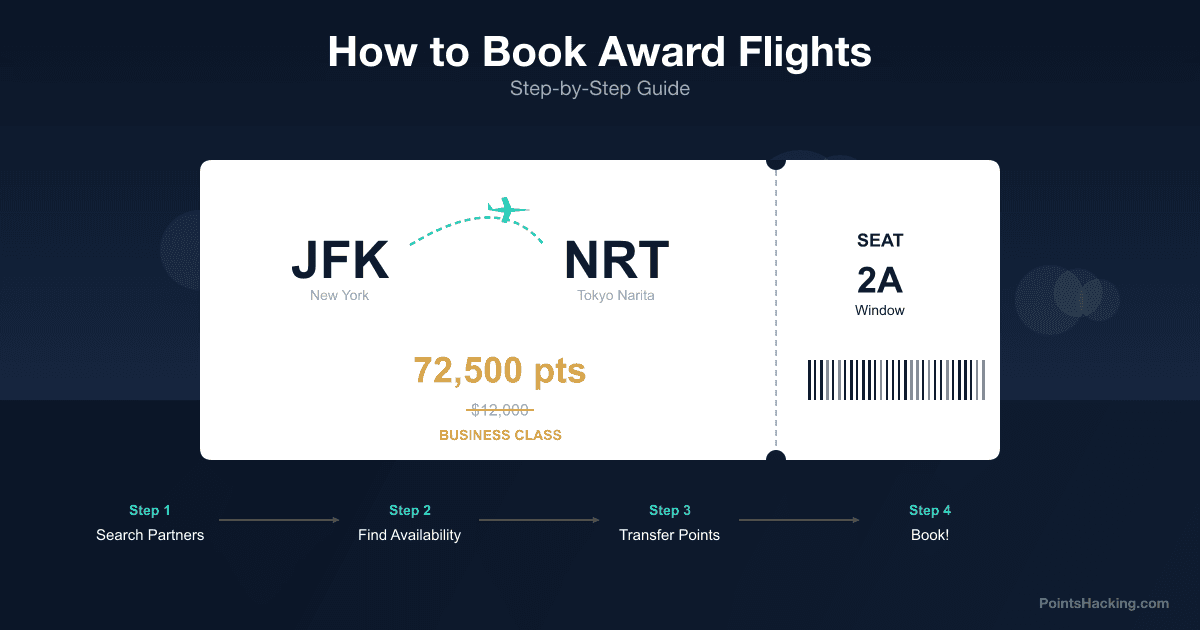
Booking an award flight is not complicated. But it is unfamiliar — and the unfamiliarity trips up beginners at exactly the wrong moments. They transfer points before finding confirmed availability. They book phantom space that disappears. They miss open dates because they are not searching correctly.
This guide walks you through the complete award booking process from first search to confirmed itinerary. Follow these steps in order and you will not make the mistakes that cost people thousands of points.
The 4-Step Award Booking Process
Every award booking follows the same four steps:
- Find confirmed availability using a search tool
- Verify the space directly on the airline's website
- Transfer your points to the partner program
- Book the award and receive confirmation
The cardinal rule: never execute Step 3 before completing Step 2. Point transfers are irreversible. If you transfer 60,000 Chase UR to United and then discover the seat is not actually bookable, those points are gone. They cannot come back.
For context on which points programs to use and when, our guide on why you should always transfer rather than buy points explains the underlying value mechanics.
Step 1: Find Availability
Award space is finite and often scarce. Airlines release a set number of award seats per flight — sometimes as few as one or two business class seats on a transatlantic route. Your first job is finding flights where award space actually exists for your travel dates.
Do not search on the airline's own website first. Airline websites are notoriously bad at showing availability across their full partner network. Instead, use dedicated award search tools built for this purpose.
Seats.aero — The most comprehensive real-time availability aggregator. It crawls award space across dozens of airlines and programs simultaneously, displays results on a calendar view, and lets you filter by cabin class, program, and route. Subscription required but worth it for anyone booking more than two awards per year. Visit seats.aero to start a search.
PointsYeah — Specializes in premium cabin award tracking with clean UI. Excellent for business and first class searches on long-haul routes.
Roame — Strong for aspirational one-stop multi-city itinerary searches. Shows routing options you would not find on a direct search.
When searching, use these strategies to find more availability:
Be date flexible. Award space opens and closes unpredictably. Searching one fixed date shows you one slice of availability. Search an entire month on a calendar view to see which dates have open seats. Most award search tools display this as a grid — green cells mean space available, red means none.
Search one-ways separately. Round-trip award searches often show fewer options than booking two separate one-ways. An outbound from JFK to LHR might have zero space in business class on the dates you want, but searching LHR to JFK for the return separately often reveals more routing options at different prices.
Consider nearby airports. EWR and JFK are interchangeable for many programs. CDG and LHR serve the same destination. BOS might have award space when JFK is sold out. Search alternative origin and destination airports if your primary route is dry.
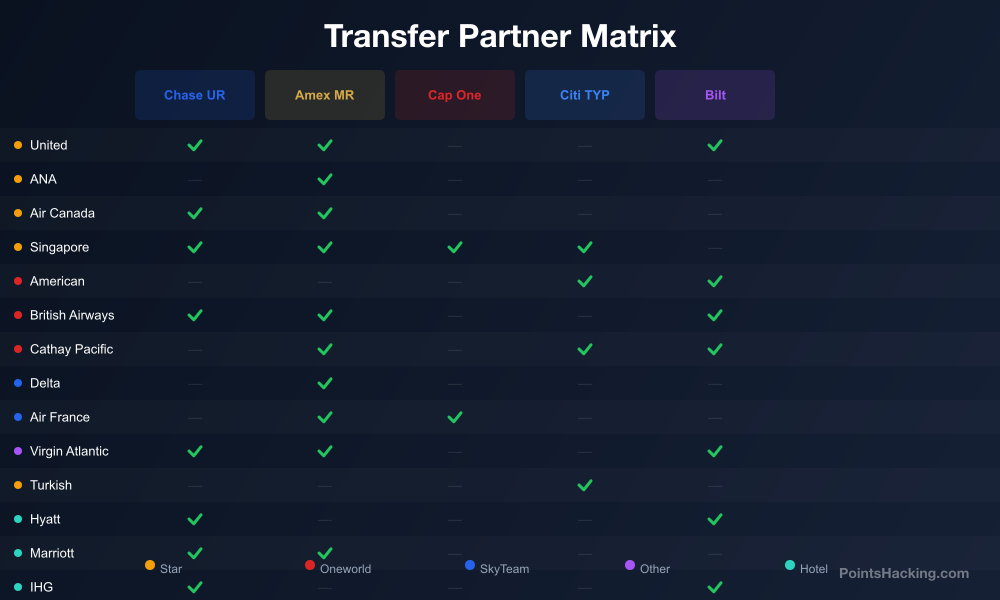
Search partner airlines, not just the operating carrier. A United flight can be booked with Chase UR transferred to United, but it can also be booked with Avianca LifeMiles, Air Canada Aeroplan, Turkish Miles&Smiles, or Singapore KrisFlyer — often at lower mileage costs. The award search tools show you all available booking programs for each flight segment.
Step 2: Verify on the Airline Website
Once you find available space on a search tool, do not transfer your points yet. First, verify that the exact seat exists on the operating airline's website or the booking program's website.
This is the phantom availability check. Third-party tools display cached data — sometimes seconds or minutes old, sometimes hours old. Award space that shows available in the search tool may already be booked by the time you look. Confirming on the source eliminates this risk.
How to verify:
- Go to the website of the program you intend to book through (e.g., United.com for United MileagePlus, Avianca's site for LifeMiles)
- Search the exact same flight: origin, destination, date, cabin class
- Confirm the award shows as bookable and at the same mileage cost
- Take a screenshot with the timestamp visible
If the space does not appear on the booking program's own site, it is phantom — stop here and search again. If it appears and the price matches, you are clear to proceed.
One nuance: some programs show space on their search engine but require calling an agent to book partner awards. Singapore KrisFlyer and certain Avianca LifeMiles itineraries fall into this category. If online booking fails after you see space, call the airline's award booking desk before giving up.
Step 3: Transfer Your Points
You have confirmed availability. Now transfer your points. Log into your credit card program's account (Chase, Amex, Capital One, Citi, or Bilt) and initiate the transfer to the partner program.
Before transferring, check for active transfer bonuses. Banks periodically offer 15-40% bonus miles when transferring to specific partners. If Amex is running a 30% bonus to Air France Flying Blue and you need 60,000 Flying Blue miles for your booking, you only need to transfer 46,000 Amex MR instead. That is 14,000 points saved — worth $280-$420 in future value.
Our Chase Ultimate Rewards complete guide covers which Chase transfer partners currently have bonus offers and how to track them.
Transfer timing by program:
- Chase to United: Instant
- Chase to Hyatt: Instant
- Chase to Singapore: Up to 48 hours
- Amex to Delta: Instant
- Amex to Air France: Instant to 24 hours
- Amex to ANA: Up to 48 hours
- Capital One to Air Canada Aeroplan: Instant
- Citi to Turkish: Instant
Do not book a same-day departure when transferring. Give yourself 24-72 hours of buffer between initiating the transfer and when you need the points to book. For programs that take up to 48 hours, this buffer is essential.
Step 4: Book the Award
Points in your account. Space verified. Now book.
Go to the booking program's website (or call their awards desk). Search the same itinerary. Select the award space. The system will show you the mileage cost and any taxes and fees due at booking.
Award tickets almost always have taxes and fees payable in cash. U.S.-originating flights typically have minimal fees ($5.60 in U.S. government taxes per segment). International carriers on partner awards often add fuel surcharges — British Airways imposes large YQ carrier surcharges, which is why many points hackers book BA-operated flights through other Avios-based programs (Iberia, Aer Lingus) or through partner programs that waive surcharges.
Pay the fees, enter your passenger details, and confirm the booking. You will receive an email confirmation with a record locator number. Cross-reference this number directly on the operating airline's website to confirm the reservation appears in their system.
Booking Windows
When you search for award space matters as much as how you search. Airlines release award seats in waves:
Far out (330-360 days): Many airlines release premium cabin award inventory 330-360 days before departure. This is when the most business and first class seats are available. If you have a specific date in mind, set a calendar reminder to search exactly 330 days before your travel date.
Close-in (0-30 days): Airlines often release unsold premium seats 0-21 days before departure rather than fly them empty. If you are flexible on departure date and willing to book last-minute, this window sometimes reveals business class seats that were sold out for months.
Mid-window (60-180 days): The driest window for premium awards. Most seats released far-out have been booked; the close-in dump has not happened yet. Economy awards are more available in this window than premium cabin.
Stopovers and Open-Jaws
Many award programs allow stopovers — spending 24+ hours in a connecting city — as part of a single award ticket at no extra cost. This is one of the most underused features in the award booking world.
Example: ANA MileagePlus allows a free stopover on round-trip transpacific awards. You could fly JFK-Tokyo-JFK and add a stopover in Tokyo for a week without paying extra miles. Singapore KrisFlyer allows stopovers on round-trip awards routed through Singapore.
Open-jaws — flying into one city and returning from another — are also available in many programs. JFK to Paris, return from Rome to JFK on a single award. This effectively gives you two cities for the price of one routing.
Always check the specific program's stopover and open-jaw rules before planning complex itineraries. Rules vary significantly between programs and can make a seemingly expensive multi-city trip bookable as a single, simpler award.
Positioning Flights
The award space you want may not exist from your home airport. A business class award from New York to Tokyo might be fully booked, but the same routing exists from Los Angeles to Tokyo. The solution: a positioning flight.
A positioning flight is a cheap cash or domestic award flight from your home airport to the city where your international award departs. EWR-LAX in economy for $150 cash or 5,000 miles, then board your LAX-NRT business class award.
Positioning flights expand your search significantly. If you live in a mid-size market without international award space, always search the major hub cities (JFK, LAX, ORD, MIA, SFO, EWR) as your origin. The total trip cost — positioning flight plus award — often beats a mediocre direct redemption from your home city.
Common Mistakes to Avoid
Transferring before verifying: The most expensive mistake. Always confirm space on the airline's own website before clicking transfer.
Searching only one program: The same flight can often be booked through multiple programs at different mileage costs. A United flight to Europe booked with Avianca LifeMiles at 55,000 miles might cost 88,000 United MileagePlus miles. Compare pricing across all eligible programs before choosing where to transfer.
Ignoring fuel surcharges: Some programs pass carrier-imposed surcharges to the customer. Check the total cost (miles plus cash) before committing. British Airways Avios on BA-operated transatlantic flights can add $400-$700 in surcharges — often more than an economy cash ticket.
Not tracking your search tools: Award availability changes daily. A seat that was unavailable when you searched last week might open today. Set alerts on Seats.aero for your target route and let the tool notify you when space appears. Our full breakdown of best award flight search tools in 2026 covers how to set up automated alerts on each platform.
Booking non-refundable awards for uncertain trips: Most award tickets can be canceled and points redeposited — but sometimes for a fee ($50-$150 per United or Delta cancelation). Amex Fine Hotels booked on award points may have stricter policies. Read the cancelation terms before booking any non-flexible date.
One-Way vs. Round-Trip Awards
One-way awards have become the norm for most programs. Booking two separate one-ways often provides more flexibility and equal or better value than a round-trip award ticket.
Advantages of one-way awards:
- Mix programs for outbound and return (e.g., ANA for JFK-NRT, Singapore KrisFlyer for NRT-JFK)
- Book outbound when space opens (330 days out) and return separately when return space becomes available
- Cancel one leg without affecting the other
- Route through different hubs on each direction
Round-trip awards are still worth considering when the program offers a meaningful discount for round-trips (rare but it happens) or when a stopover rule requires a round-trip ticket to apply.
For most modern award bookings, default to two one-ways unless you have a specific reason to book round-trip. The flexibility advantage is too significant to ignore.