Delta SkyMiles is the airline currency that loyalty enthusiasts love to hate. No published award chart. Dynamic pricing that fluctuates wildly depending on demand, route, and booking window. Redemptions that sometimes cost 80,000 miles for a domestic economy seat that sells for $200 in cash. The running joke in points circles is that SkyMiles are worth "whatever Delta feels like charging today."
And yet, Delta SkyMiles remain one of the most commonly earned airline currencies in America. The Amex/Delta co-branded cards are among the most popular airline credit cards on the market. Amex Membership Rewards transfers to Delta at 1:1. And Delta, for all its pricing opacity, still operates the largest and most reliable domestic network, with a product that consistently ranks among the top U.S. carriers.
So are SkyMiles actually worth earning in 2026? The honest answer: it depends entirely on how you plan to use them. This guide breaks down the real value of SkyMiles, where the sweet spots hide, when to avoid them entirely, how the co-branded cards stack up, and how Delta compares to United, American, and Southwest.
Dynamic Pricing: Why Delta SkyMiles Are Unpredictable
Delta eliminated its published award chart in 2015, meaning award prices are set by algorithm with no guaranteed floor or ceiling.
Before 2015, Delta published a fixed award chart. A domestic economy round-trip cost 25,000 SkyMiles. A one-way business class to Europe cost 62,500. You could plan around those numbers. When Delta removed the chart, it became the first major U.S. airline to shift entirely to dynamic award pricing, where the points price of a seat moves in real time based on demand, cash fare levels, cabin load, and traveler status.
In practice, this means:
- Domestic economy awards range from 5,000 to 80,000+ SkyMiles one-way for the exact same route depending on date, time, and how full the flight is. A Los Angeles to New York one-way might cost 12,000 miles on a Tuesday in February and 68,000 miles on a Friday in December.
- International business class can cost 150,000 to 400,000+ SkyMiles round-trip. A Delta One seat to Paris might price at 180,000 SkyMiles during a low-demand period or 380,000 during peak summer travel. There is no published price, and there is no way to predict the cost until you search.
- Partner awards on non-Delta metal (Air France, KLM, Virgin Atlantic, Korean Air) sometimes follow legacy zone-based pricing and sometimes follow dynamic pricing, depending on the route and partner. This inconsistency makes planning difficult.
The fundamental problem is that without a published chart, you cannot calculate the value of a SkyMile in advance. Every other major U.S. airline (United, American, Southwest) publishes award charts or follows more predictable pricing structures. Delta's opacity means you have to search specific routes and dates to know what your miles are worth on any given trip.
What Are SkyMiles Actually Worth Per Mile?
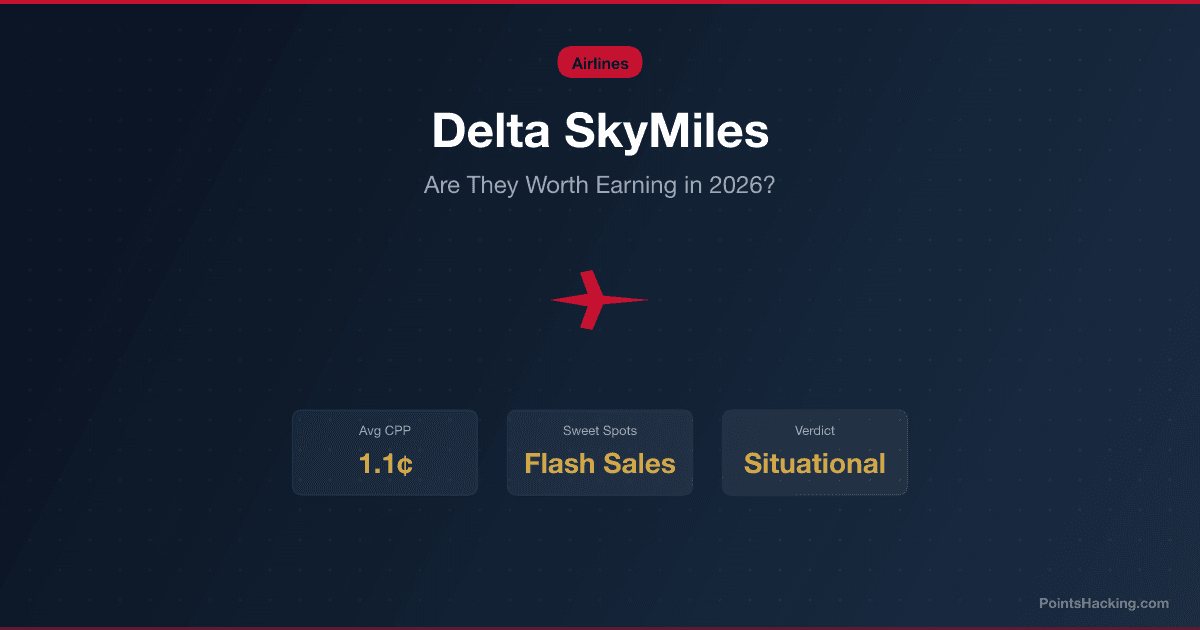
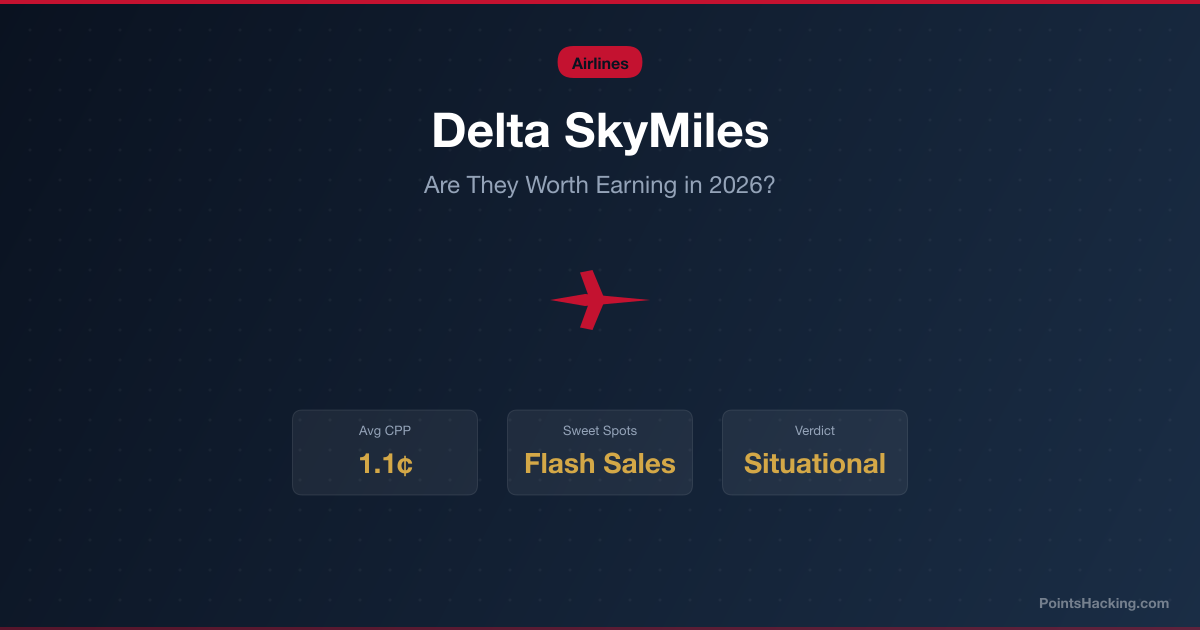
On average, Delta SkyMiles deliver 1.0 to 1.2 cents per mile in domestic economy, but the range swings from 0.5 cents to 4+ cents depending on the booking.
Because Delta uses dynamic pricing, there is no single valuation for a SkyMile. Industry publications like The Points Guy, NerdWallet, and Frequent Miler peg the average around 1.2 cents per SkyMile. But that average masks enormous variance:
Worst case (0.5 to 0.8 CPM): Peak domestic economy flights where Delta inflates award prices. A $250 one-way domestic ticket priced at 45,000 SkyMiles delivers only 0.56 cents per mile. This happens frequently during holidays, weekends, and summer travel on popular routes.
Average case (1.0 to 1.3 CPM): Off-peak domestic economy or transatlantic economy during shoulder season. A $350 round-trip from Atlanta to New York priced at 28,000 SkyMiles delivers 1.25 cents per mile. This is the typical experience for most SkyMiles users.
Best case (1.5 to 4+ CPM): SkyMiles flash sales (covered below), partner awards through Virgin Atlantic or Air France, and Delta One business class during low-demand periods. A Delta One seat to Europe priced at $3,500 in cash and 120,000 SkyMiles delivers 2.9 cents per mile. Flash sales can push the value above 4 cents per mile on certain routes.
For comparison, here is how Delta stacks against other major airline currencies at their average redemption values:
- United MileagePlus: ~1.3 cents per mile (fixed award chart for many routes, dynamic for some)
- American AAdvantage: ~1.4 cents per mile (web specials and partner sweet spots)
- Southwest Rapid Rewards: ~1.4 cents per point (fixed revenue-based, predictable)
- Delta SkyMiles: ~1.2 cents per mile (highly variable, skewed by poor peak pricing)
Delta consistently trails the other three in average value per mile. But averages do not tell the full story. The sweet spots below can push SkyMiles above what United or American deliver on comparable routes.
The Sweet Spots: Where SkyMiles Still Win
SkyMiles flash sales, partner awards through Virgin Atlantic and KLM, and Amex transfer bonuses can deliver 2 to 5 cents per mile, making Delta miles genuinely valuable on specific bookings.
Sweet Spot 1: SkyMiles Flash Sales
Delta periodically runs unadvertised flash sales on award pricing. These sales slash SkyMiles costs on specific routes by 30 to 70%, creating some of the best redemption values in the program. Examples from recent flash sales:
- Round-trip domestic flights for 5,000 to 10,000 SkyMiles (normally 15,000 to 30,000)
- Round-trip to Europe in economy for 26,000 SkyMiles (normally 60,000 to 80,000)
- Round-trip to Asia in economy for 35,000 SkyMiles (normally 70,000 to 120,000)
A $500 round-trip to Europe priced at 26,000 SkyMiles during a flash sale delivers 1.9 cents per mile. A $300 domestic ticket at 8,000 SkyMiles delivers 3.75 cents per mile. These sales appear without warning and last 48 to 72 hours. Following deal-alert services like Secret Flying, The Points Guy, or our own deal alerts page is the only way to catch them consistently.
Sweet Spot 2: Partner Awards via Virgin Atlantic
Virgin Atlantic Flying Club is a transfer partner of both Amex Membership Rewards and Chase Ultimate Rewards. Virgin Atlantic can book Delta-operated flights at prices that sometimes beat Delta's own SkyMiles pricing. A Delta One seat from New York to London might cost 50,000 Virgin Atlantic miles booked through Virgin Atlantic's website, while the same seat costs 150,000+ SkyMiles booked through Delta directly.
This creates an arbitrage: transfer Amex MR or Chase UR to Virgin Atlantic at 1:1, then book Delta metal through Virgin Atlantic at the lower price. You use fewer miles and access the same seat. The catch is that availability through Virgin Atlantic may not match what Delta shows directly, so you need to search both sites.
Sweet Spot 3: Air France/KLM Flying Blue Partner Awards
Air France/KLM Flying Blue runs monthly Promo Rewards sales that discount partner award flights by 25 to 50%. These sales regularly include Delta-operated routes within the U.S. and transatlantic routes operated by Delta, Air France, or KLM. A transatlantic business class seat that costs 72,000 Flying Blue miles at standard pricing might drop to 45,000 during a Promo Rewards sale.
Transfer Chase UR or Amex MR to Flying Blue at 1:1, then book Delta or Air France/KLM metal through Flying Blue's website during a promo period. This consistently delivers 2 to 4 cents per mile in value.
Sweet Spot 4: Amex Transfer Bonuses to Delta
Amex periodically offers 15 to 40% transfer bonuses when moving Membership Rewards points to Delta SkyMiles. During a 30% bonus, 50,000 Amex MR becomes 65,000 SkyMiles. If you have already identified a specific Delta redemption with good pricing, timing your transfer to coincide with a bonus stretches your value further.
The combination of a transfer bonus plus a flash sale is the holy grail of SkyMiles value. A 30% transfer bonus combined with a flash sale pricing a $500 flight at 15,000 SkyMiles means you spend only 11,538 Amex MR for that $500 flight. That is 4.3 cents per point, which matches the best sweet spots in any airline program.
Delta Co-Branded Cards: Which One Makes Sense
Delta offers four co-branded Amex cards. The Delta Gold and Delta Platinum are worth considering for specific travelers. The Delta Reserve is a niche product for heavy Delta spenders who want Sky Club access.
Delta SkyMiles Gold Card ($150/year)
- Earn 2x miles on Delta purchases, restaurants, and U.S. supermarkets. 1x on everything else.
- First checked bag free on Delta flights (saves $35 each way, $70 round-trip).
- Main Cabin 1 priority boarding.
- Annual companion certificate: buy one domestic main cabin ticket, get a companion ticket for $0 plus taxes (typically $12 to $25). The companion cert alone can save $200 to $400 per year.
Verdict: The Delta Gold is a solid card if you fly Delta 2 or more times per year. The free checked bag benefit pays for most of the annual fee on its own ($70 per round-trip x 2 trips = $140). The companion certificate pushes the value well past the $150 fee. However, the earning rate is poor compared to transferable-points cards. You earn only 1x on most spending, whereas the Amex Gold earns 4x at restaurants and supermarkets. The Delta Gold is a benefits card, not an earning card.
Delta SkyMiles Platinum Card ($350/year)
- Earn 3x on Delta purchases, hotels, and restaurants. 2x on U.S. supermarkets and U.S. gas stations. 1x on everything else.
- First checked bag free.
- Companion certificate upgradeable to First Class or Delta One (domestic routes only). This is a significant upgrade over the Gold card's economy-only companion cert.
- Global Entry or TSA PreCheck credit ($100 every 4.5 years).
- Accelerated path to Medallion status: earn Medallion Qualifying Miles (MQMs) through card spending.
Verdict: The Platinum card makes sense for Delta loyalists who fly 6+ times per year and want the upgradeable companion certificate. The ability to book a companion in First Class on a domestic route for just taxes is a genuine sweet spot. The Medallion qualifying benefits are useful only if you are already close to earning Silver or Gold status through flying.
Delta SkyMiles Reserve Card ($650/year)
- Earn 3x on Delta purchases. 1x on everything else.
- Delta Sky Club access when flying Delta. This is the headline benefit and the primary reason to hold this card.
- Companion certificate upgradeable to First Class or Delta One.
- Global Entry or TSA PreCheck credit.
- Centurion Lounge access when flying Delta on a ticket booked with the card (secondary benefit).
Verdict: The Reserve card is solely a lounge access card. Delta Sky Club day passes cost $59 each, so you need to visit the lounge 11+ times per year to justify the $650 fee through lounge visits alone. If you are based at a Delta hub (Atlanta, Minneapolis, Detroit, Salt Lake City, Seattle, New York JFK, Los Angeles) and fly Delta 15+ times per year, the Sky Club access is genuinely valuable. For everyone else, the fee is hard to justify. The 1x earning rate on non-Delta spending is abysmal compared to any transferable-points card.
When Delta SkyMiles Make Sense
SkyMiles are worth earning when you fly Delta frequently, are based at a Delta hub, or have a specific redemption in mind that prices well in the SkyMiles program.
Here are the scenarios where earning and stockpiling SkyMiles is a reasonable strategy:
You are Delta-loyal by geography. If you live in Atlanta, Minneapolis, Detroit, Salt Lake City, or Seattle, Delta dominates your airport with more flights and more nonstop routes than any competitor. In these markets, earning SkyMiles through co-branded cards and direct flying makes sense because Delta is your most practical carrier regardless of points strategy.
You value operational reliability over award chart transparency. Delta cancels fewer flights than American or United. Its customer service during irregular operations is generally stronger. If you fly 20+ times per year and priority boarding, free checked bags, and reliable service matter more than squeezing maximum cents-per-point value from your miles, Delta is a defensible choice.
You plan to use the companion certificate. Both the Delta Gold ($150/year) and Delta Platinum ($350/year) cards include annual companion certificates. If you consistently take a partner or spouse on one domestic trip per year, the companion cert alone can save $200 to $500, making the card fee a net positive regardless of how you value SkyMiles.
You spot a flash sale or promo fare. When SkyMiles flash sales hit your routes, the value per mile can exceed 3 cents. Having a balance of SkyMiles ready to deploy during these windows is the highest-return strategy within the Delta ecosystem.
When to Avoid SkyMiles Entirely
SkyMiles are a poor choice when you want predictable award pricing, premium cabin sweet spots, or flexible transfer partner access.
Do not prioritize SkyMiles earning in these situations:
You want predictable, plannable award redemptions. Without a published chart, you cannot budget a trip in SkyMiles until you search specific dates. United and American publish charts (or at minimum, standard saver levels) that let you plan months in advance. If you want to know exactly how many miles a trip will cost before you start earning, choose United MileagePlus or American AAdvantage.
You are targeting premium cabin international travel. Delta One award pricing is wildly inconsistent and often charges 300,000+ SkyMiles for routes that United prices at 88,000 miles or American prices at 70,000 miles. For international business class, transferable points (Chase UR, Amex MR) transferred to Air France Flying Blue, Virgin Atlantic, or Air Canada Aeroplan consistently deliver better value than SkyMiles spent directly.
You want maximum flexibility. SkyMiles are locked into the Delta/SkyTeam ecosystem. Transferable credit card points can flow to 15 to 20+ airline and hotel partners. If you are not sure where you want to travel, earn transferable points and keep your options open.
You do not fly out of a Delta hub. If you are based in a market where United or American has more routes and better nonstop service, earning SkyMiles creates friction. You will find yourself connecting through Delta hubs instead of flying nonstop on a competitor. The convenience cost outweighs the loyalty benefit.
Delta vs. United vs. American vs. Southwest: Honest Comparison
United MileagePlus and American AAdvantage offer more predictable pricing and better premium cabin sweet spots. Southwest offers the most transparent value. Delta trails all three in award value consistency.
United MileagePlus
- Published saver award levels provide pricing predictability.
- Star Alliance partner access (Lufthansa, ANA, Singapore, Turkish) through United or transfer partners like Aeroplan.
- Polaris business class is a competitive international product.
- Excelsior pricing (dynamic) can be expensive, but saver awards still exist at fixed levels.
- Transfers from: Chase UR, Capital One Miles, Bilt Rewards.
- Best for: international premium cabin redemptions at predictable prices.
American AAdvantage
- Web specials offer discounted domestic and international award pricing.
- Oneworld partner access (Cathay Pacific, JAL, Qatar, British Airways) with some excellent business class sweet spots.
- AAdvantage miles earned from Citi Strata Premier (transfer partner) or Bilt Rewards.
- Partner award pricing through British Airways Avios or Alaska Mileage Plan often undercuts AA's own program.
- Transfers from: Citi ThankYou Points, Bilt Rewards.
- Best for: Oneworld alliance sweet spots and domestic web specials.
Southwest Rapid Rewards
- Revenue-based: every point is worth a fixed ~1.4 cents toward any seat. No blackout dates, no capacity controls.
- No partner airlines (Southwest only), but the Companion Pass (135,000 points in a calendar year) makes a designated companion fly free for up to 2 years.
- Transfers from: Chase UR.
- Best for: domestic travelers who want simplicity, no fees, and the Companion Pass.
Delta SkyMiles
- No published chart. Dynamic pricing means wild variance in value.
- SkyTeam partner access (Air France, KLM, Korean Air, Virgin Atlantic) but direct SkyMiles pricing on partner flights is often poor.
- Delta One is a good product, but award pricing for it is the worst among U.S. carriers on a per-mile basis.
- Transfers from: Amex MR, Virgin Atlantic (for booking Delta metal at lower prices).
- Best for: Delta hub captives, companion cert users, and flash sale opportunists.
The Best Strategy for Delta SkyMiles in 2026
Earn SkyMiles passively through Amex transfer bonuses and co-branded card benefits. Never make SkyMiles your primary earning target over transferable currencies.
Here is the optimal approach for maximizing Delta SkyMiles value in 2026:
Step 1: Earn transferable Amex MR as your primary currency. The Amex Gold (4x dining, 4x U.S. supermarkets) and Amex Platinum (5x flights booked directly) earn Membership Rewards points that can transfer to Delta at 1:1, but can also transfer to 20+ other airline and hotel partners. This keeps your options open. If a great Delta redemption appears, transfer and book. If a better opportunity exists through ANA, Virgin Atlantic, Air France, or Hyatt, transfer there instead.
Step 2: Hold one Delta co-branded card for the benefits, not the earning rate. The Delta Gold ($150/year) provides free checked bags and a companion certificate. These benefits have value regardless of SkyMiles pricing. Use the card only for Delta purchases (to earn 2x SkyMiles), not for general spending.
Step 3: Monitor SkyMiles flash sales and Flying Blue Promo Rewards. Keep a moderate SkyMiles balance (50,000 to 100,000) in reserve for when flash sales or partner promotions create genuine value. Do not hoard SkyMiles speculatively, because dynamic pricing means there is no guarantee of future value at any specific level.
Step 4: Book Delta metal through partner programs when possible. Virgin Atlantic for Delta One transatlantic. Flying Blue for Delta-operated routes during Promo Rewards sales. These partner booking routes frequently beat Delta's own SkyMiles pricing for the same seat.
Step 5: Use the companion certificate strategically. The Delta Gold companion certificate lets you buy one main cabin ticket and add a companion for just taxes. The Delta Platinum certificate upgrades the companion to First Class on domestic routes. Time your companion cert usage for high-fare routes (transcontinental, holiday travel, last-minute bookings) where the cash savings are largest.
The Bottom Line on Delta SkyMiles
Delta SkyMiles are the weakest major U.S. airline currency on a per-mile basis, but they are not worthless. The right strategy treats them as a secondary currency, not a primary one.
The honest assessment: if you could choose to earn 100,000 United MileagePlus miles or 100,000 Delta SkyMiles, the United miles would deliver more value in nearly every scenario. United publishes saver award levels, offers Star Alliance partner access at fixed prices, and transfers from Chase UR (the most versatile credit card program). Delta offers unpredictable dynamic pricing, fewer transfer partner options for booking Delta metal at fair prices, and a co-branded card lineup that earns a locked-in, less flexible currency.
But SkyMiles are not a write-off. The companion certificate on Delta co-branded cards is a genuine, quantifiable benefit. Flash sales create sporadic but real value. Partner bookings through Virgin Atlantic and Flying Blue consistently deliver 2 to 5+ cents per mile. And the operational reliability of the Delta network matters to road warriors who fly 30+ segments per year.
The winning strategy: earn flexible Amex MR points that can flow to Delta when the deal is right, hold a Delta Gold card for the checked bag and companion cert, and never make SkyMiles your primary earning target. Let your transferable points do the heavy lifting, and deploy them to Delta only when the math actually works in your favor.