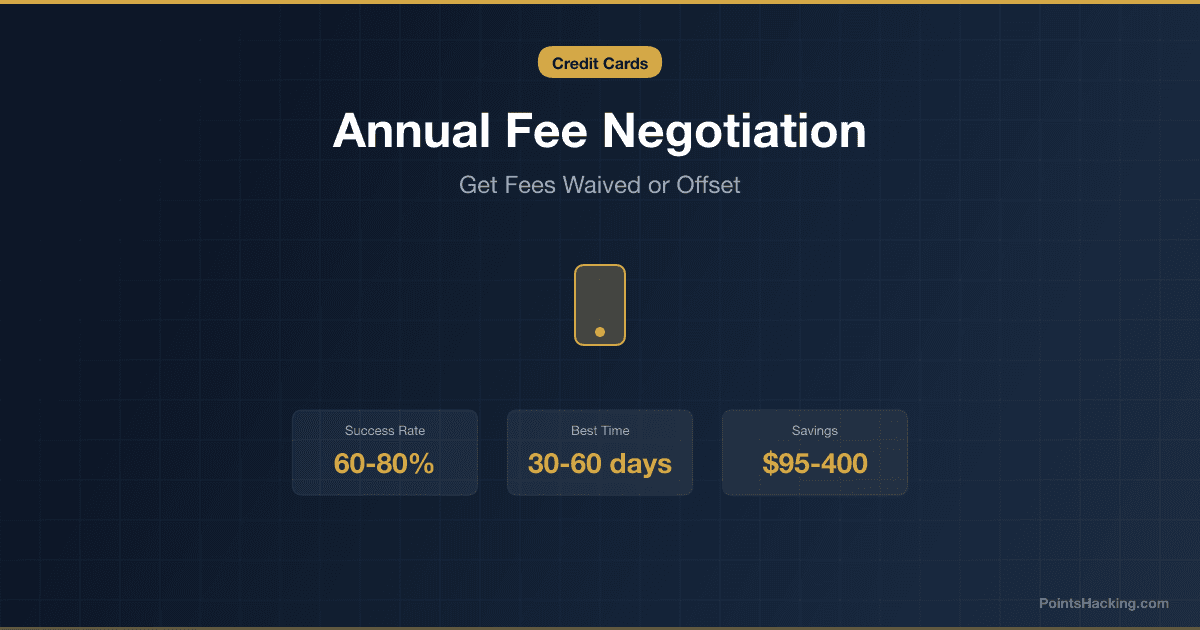
Every year, millions of credit card holders pay annual fees without realizing they can negotiate them. Retention departments at every major card issuer have a budget specifically allocated to keeping profitable cardholders from canceling. The offers sitting in that budget, statement credits, bonus points, reduced fees, and waived fees, are only available to people who pick up the phone and ask.
This guide covers the exact process for negotiating your annual fee with Chase, American Express, Citi, and Capital One. You will learn when to call, what to say, which cards have the best and worst retention offer track records, and how to run the math on whether to keep, downgrade, or cancel any card in your wallet. The strategies here apply to virtually every card with an annual fee, from $95 starter cards to $695 premium products.
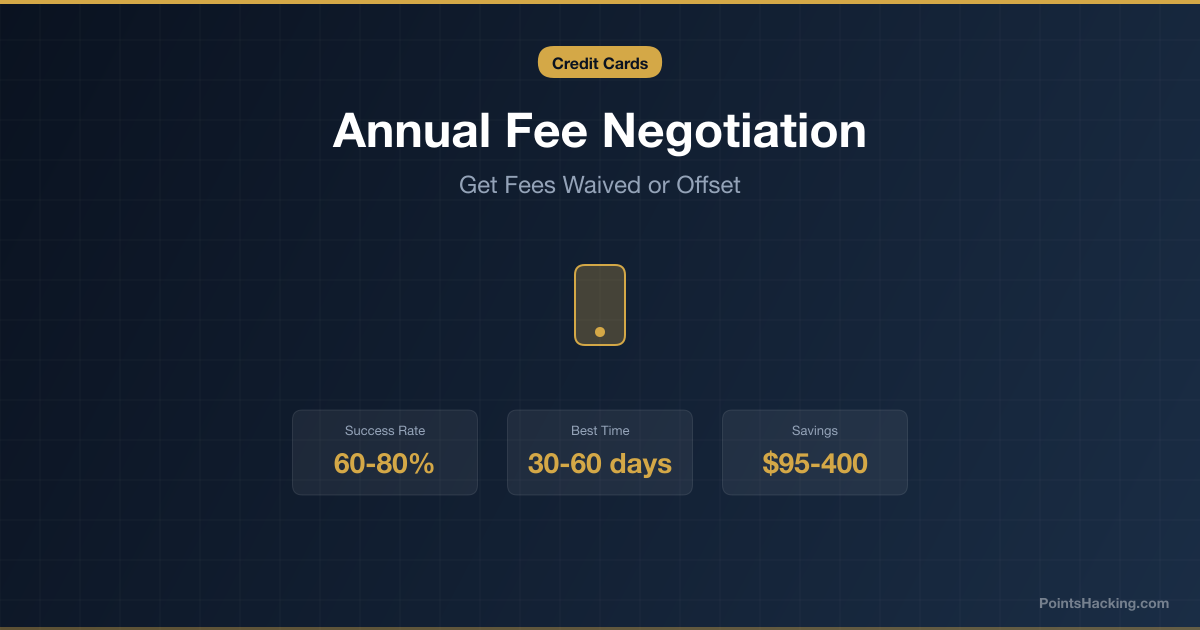
When to Call: The 30 to 60 Day Window
Call your card issuer 30 to 60 days before your annual fee posts to your statement. This timing gives you maximum leverage while keeping all options open.
Here is why this window matters. If you call too early (more than 90 days before the fee), the retention system may not flag your account for an offer because the fee event has not triggered yet. If you call too late (after the fee posts), you can still get it refunded at most issuers, but you lose negotiating leverage because the issuer knows you have already committed to another year of the card.
The sweet spot is 30 to 45 days before the annual fee appears. At this point, the issuer's retention system recognizes that you are approaching a decision point, and the retention specialist has the most flexibility to offer you incentives to stay.
How do you know when the fee will post? Check your last year's statement from the month your card was opened. Annual fees typically post in the same billing cycle each year. If you opened your Chase Sapphire Reserve in March, expect the annual fee on your March or April statement. Set a calendar reminder for 45 days before that date.
If you miss the window and the fee has already posted, you still have options. Most issuers allow you to close or downgrade the card within 30 to 41 days of the fee posting and receive a full refund of the annual fee. American Express is an exception: they prorate annual fee refunds, so the sooner you act after the fee posts, the more you get back.
How to Call: The Retention Department Process
When you call the number on the back of your credit card, you will reach a general customer service representative first. Your goal is to reach the retention department, which is a specialized team with the authority to offer statement credits, bonus points, and fee waivers. General reps typically cannot make these offers.
Step 1: Call the number on the back of your card. When prompted, say "cancel card" or "close account." This routes you to the retention team (sometimes called "Member Services" at Amex or "Account Services" at Chase).
Step 2: When the retention specialist answers, explain that you are considering whether to keep the card because the annual fee is coming up. Be polite, direct, and honest. Do not threaten or bluff. Retention specialists handle dozens of these calls daily and respond best to straightforward conversations.
Step 3: Listen to what they offer. The first offer may not be their best. If the initial offer is a small statement credit (say $50 on a $250 annual fee), you can politely say that you were hoping for something closer to the full fee amount, or that you would need a better offer to justify keeping the card. In many cases, the specialist will check for a second, better offer.
Step 4: Accept, decline, or ask for time. You do not have to make a decision on the call. You can say "Let me think about that and call back." The offer will typically remain available for 30 days.
The entire call takes 5 to 15 minutes. The worst-case outcome is that they offer nothing and you downgrade or cancel the card, which you can do on the same call. The best-case outcome is hundreds of dollars in statement credits or tens of thousands of bonus points.
Scripts That Work for Each Major Issuer
Each card issuer has a distinct retention culture. Some are generous and proactive (American Express). Others are stingy and require persistence (Capital One). Here are proven scripts tailored to each issuer's style.
Chase
Chase's retention offers tend to be moderate: statement credits in the $50 to $150 range or bonus points of 5,000 to 15,000 Ultimate Rewards. Chase is less likely to waive the full annual fee than Amex, but they almost always have something to offer on the Sapphire Preferred and Sapphire Reserve.
Script: "Hi, I've had the Sapphire Reserve for [X years] and the annual fee is coming up. I really like the card, but I'm evaluating whether the fee makes sense for me this year given my spending. Are there any retention offers or credits available to help offset the annual fee?"
If the first offer is low: "I appreciate that. Is there anything else available? I've been a loyal customer and I'd love to keep the card, but I'd need something closer to [specific amount] to make the math work."
American Express
Amex has the most generous retention program in the industry. Retention offers on premium cards like the Platinum and Gold frequently include 20,000 to 55,000 bonus Membership Rewards points or $150 to $300 in statement credits. Amex's system often has multiple offers available for the same card, and some are targeted (meaning the system shows them to the rep based on your account profile).
Script: "I'm calling about my Platinum Card. The annual fee is renewing soon and I wanted to see if there are any retention offers on my account. I've enjoyed the card, but at $695, I want to make sure I'm getting enough value to justify keeping it."
If the offer is points-based and you prefer cash: "That's a great offer. I'm curious, is there a statement credit option available as well? I'd like to compare before deciding." Amex reps will often check for both types.
Citi
Citi's retention offers are inconsistent. Some cardholders receive generous offers (statement credits of $75 to $150 or bonus ThankYou points), while others are told nothing is available. Citi's system appears heavily dependent on your spending history on the card. High spenders get better offers.
Script: "I'm considering whether to keep my Citi Strata Premier. The annual fee is coming up and I'd like to know if there are any offers available to help with the fee. I've been using the card regularly for [dining/travel/specific category]."
If declined: "I understand. If nothing is available now, could you check again in a few weeks? My fee posts on [date] and I'd like to have an offer before I make a final decision." Call back in 2 weeks. Citi's system sometimes generates new offers closer to the fee date.
Capital One
Capital One is historically the stingiest major issuer for retention offers. Many cardholders report being offered nothing or very small credits ($25 to $50) on the Venture X ($395 annual fee) and Venture ($95 annual fee). This has improved slightly in recent years, but Capital One still lags behind Amex and Chase.
Script: "Hi, I'm calling about my Venture X card. The annual fee is approaching and I'm weighing my options. I've enjoyed the card, but with other cards offering similar benefits at competitive fees, I'm wondering if there are any retention incentives available."
With Capital One, the downgrade path is often more productive than the retention path. If no offer is available, ask about downgrading to a no-annual-fee card (the Capital One Quicksilver) to preserve your credit line and account history.
Types of Retention Offers and Their Value
Retention departments typically offer one of four types of incentives. Understanding the value of each helps you compare offers and negotiate effectively.
Statement Credits: Cash applied directly to your account. A $150 statement credit on a $250 annual fee means your effective fee is $100. This is the simplest form of retention offer and the easiest to value. Credits are guaranteed value.
Bonus Points/Miles: Additional points credited to your account, sometimes with a spending requirement ("10,000 bonus points after $1,000 in spend in the next 3 months") and sometimes with no requirement. Value these at your typical redemption rate. If you redeem Amex MR at 2 cents per point, 30,000 bonus points equals $600 in value.
Reduced Annual Fee: The issuer charges you a lower fee for the next year. This is less common than credits or points but does happen, particularly with Amex. A $695 Platinum fee reduced to $495 for one year is a $200 savings.
Fee Waiver: The full annual fee is waived for the coming year. This is rare on premium cards but does happen on mid-tier cards ($95 to $250 annual fees), particularly for long-tenured cardholders with high spending. Amex is the most likely issuer to offer a full waiver on cards in the $150 to $250 range.
The Math: When to Keep vs. Cancel a Card
Not every card is worth keeping, even with a retention offer. The decision comes down to a simple equation: does the total value you extract from the card (benefits + credits + retention offer) exceed the annual fee?
Here is the framework.
Step 1: List every benefit you actually use. For a Chase Sapphire Reserve ($550 annual fee), that might include: $300 travel credit (used in full), Priority Pass lounge access (used 10 times, valued at $30 per visit = $300), 3x points on dining (earned 30,000 points on $10,000 dining spend, valued at $600 at 2 CPP), and DoorDash credits ($60/year). Total usable value: $1,260.
Step 2: Add the retention offer. If Chase offers a $100 statement credit, your total value is $1,360.
Step 3: Subtract the annual fee. $1,360 minus $550 = $810 net positive. The card is clearly worth keeping.
Now run the same math for a card you barely use. If your Amex Green Card ($150 annual fee) earns you 5,000 points per year ($100 at 2 CPP) and the retention offer is 5,000 bonus points ($100), your total value is $200 against a $150 fee. Net positive of $50. That is marginal. You might keep it for one more year, but if the retention offer disappears next year, the card becomes a net negative.
The key insight: be honest about which benefits you actually use, not which benefits the card theoretically offers. A $200 airline credit is worth $200 only if you spend $200 on airlines. If you buy a random airline gift card just to trigger the credit, the value is less than $200 because you are spending money you would not otherwise spend.
Product Change (Downgrade) Strategy
If retention offers are not enough to justify the annual fee, the next move is a product change, also called a downgrade. This converts your current card to a different card within the same issuer's family, preserving your credit line and account history while eliminating or reducing the annual fee.
Why this matters: Closing a credit card reduces your total available credit and can shorten your average account age, both of which can temporarily lower your credit score. A product change avoids both problems. Your credit line stays intact, your account history is preserved, and your utilization ratio remains unchanged.
Chase downgrades: The Chase Sapphire Reserve ($550) and Sapphire Preferred ($95) can both be downgraded to a Chase Freedom Flex or Chase Freedom Unlimited, both of which have no annual fee. Your credit line transfers to the new card. Any Ultimate Rewards points in your Sapphire account are preserved in the new card's program (though you lose the ability to transfer to partners unless you have another Sapphire or Ink card).
Amex downgrades: The Amex Platinum ($695) can be downgraded to an Amex Green ($150) or Amex EveryDay (no annual fee). The Amex Gold ($325) can be downgraded to the EveryDay card. Note that Amex has a strict rule: you must have held a card for at least 12 months before product changing it.
Citi downgrades: The Citi Strata Premier ($95) can be downgraded to the Citi Double Cash (no annual fee). The Citi Prestige (if you still hold one) can be downgraded to the Double Cash or Rewards+ card.
Capital One downgrades: The Capital One Venture X ($395) and Venture ($95) can both be downgraded to the Capital One Quicksilver (no annual fee). Capital One makes this process straightforward and typically processes it during a single phone call.
How Built-In Credits Offset Premium Annual Fees
Premium cards with high annual fees often include statement credits that substantially reduce the effective annual cost. Understanding these credits is essential before deciding whether a retention offer makes the card worthwhile.
American Express Platinum ($695 annual fee):
- $200 airline fee credit (covers incidentals like seat upgrades, baggage, and in-flight purchases on one selected airline)
- $200 hotel credit (on prepaid Fine Hotels + Resorts and Hotel Collection bookings through Amex Travel)
- $200 Uber Cash ($15/month, plus an additional $20 in December)
- $155 Walmart+ credit (covers the cost of an annual Walmart+ membership)
- $240 digital entertainment credit ($20/month toward eligible streaming subscriptions)
- $189 CLEAR Plus credit
- $100 Saks Fifth Avenue credit ($50 semi-annually)
Total embedded credits: approximately $1,284. Even if you use only the Uber Cash, airline credit, and streaming credit ($640 combined), the effective annual fee drops to $55. Add a retention offer of 30,000 MR points ($600 in value), and the card pays for itself several times over.
Chase Sapphire Reserve ($550 annual fee):
- $300 annual travel credit (automatically applied to any travel purchase)
The effective annual fee after the travel credit is $250. If you travel at all during the year, this credit is essentially automatic. A retention offer of $100 to $150 brings the effective fee down to $100 to $150, which is easily justified by the 3x earning rate on dining and travel, Priority Pass lounge access, and the 1.5x point multiplier in the Chase travel portal.
Capital One Venture X ($395 annual fee):
- $300 annual travel credit (on bookings through the Capital One Travel portal)
- 10,000 bonus miles on each account anniversary
The anniversary bonus is worth roughly $100 in redemptions. Combined with the $300 travel credit, the effective annual fee is close to zero before any retention offer. This is why the Venture X is widely considered one of the best values in premium credit cards, even without negotiation.
Which Cards Are Easiest and Hardest to Get Retention Offers On
Based on community data and years of reported outcomes, here is a rough ranking of card retention offer availability from most generous to least.
Easiest (high success rate, generous offers):
- Amex Platinum: 80%+ success rate, offers typically 20,000 to 55,000 MR points or $150 to $300 credit
- Amex Gold: 75%+ success rate, offers typically 10,000 to 30,000 MR points or $75 to $150 credit
- Chase Sapphire Reserve: 70%+ success rate, offers typically $50 to $150 credit or 5,000 to 15,000 UR points
- Chase Sapphire Preferred: 65%+ success rate, offers typically $50 to $75 credit or 5,000 to 10,000 UR points
Moderate (mixed results):
- Citi Strata Premier: 50% success rate, offers vary widely, $50 to $100 credit or 5,000 to 10,000 TYP
- Amex Green: 60% success rate, but offers are smaller (5,000 to 15,000 MR points)
- Hilton Aspire: 60% success rate, but the card's built-in benefits often make retention offers unnecessary
Hardest (low success rate, small offers):
- Capital One Venture X: 30 to 40% success rate, small credits when offered ($25 to $75)
- Capital One Venture: 25 to 35% success rate
- Chase co-branded cards (United, Marriott, IHG): 40% success rate, usually small credits or bonus miles
These percentages are approximate and based on aggregated community reports. Your individual results will depend on your spending history, tenure with the issuer, and what the system surfaces for your specific account. Higher spenders consistently receive better offers.
How Often Can You Get Retention Offers?
Most issuers will provide a retention offer once per year, per card. You can call every year when the annual fee approaches, and many cardholders do exactly that, building it into an annual routine.
Amex: You can generally receive a retention offer every 13 months (one per annual fee cycle). Some cardholders report receiving offers more frequently, particularly on the Platinum and Gold cards, but the standard cadence is once per year.
Chase: Once per year per card. Chase's system is fairly consistent: if you received a retention offer last year, you are likely to receive one again this year as long as your spending has remained steady.
Citi: Unpredictable. Some years you get an offer, some years nothing. Spending heavily on the card in the 3 months before calling seems to improve your chances.
Capital One: Once per year, but the offer rate is low to begin with. If you were declined a retention offer, calling back 2 to 4 weeks later sometimes generates a new result, as Capital One's system can update between calls.
The annual retention call takes 10 to 15 minutes and can save you $100 to $700 per card. Across a wallet of 3 to 5 premium cards, that is $300 to $3,500 in annual savings for less than an hour of phone calls. There is no higher-ROI activity in personal finance.
Mistakes to Avoid When Negotiating
A few common errors can reduce your chances of getting a good retention offer or create problems for your points strategy.
Do not threaten to cancel unless you mean it. If you say "I'm going to cancel this card today" and the rep says "OK, I can process that for you," you may find yourself accidentally closing a card you wanted to keep. Use language like "I'm considering my options" or "I'm evaluating whether to keep the card" rather than ultimatums.
Do not accept the first offer without asking if anything better is available. Retention specialists often have access to multiple offers. The first one they present is not always the best. A simple "Is there anything else available?" can unlock a significantly better deal.
Do not cancel Amex cards you have held for less than 12 months. American Express has an unofficial "once in a lifetime" rule on sign-up bonuses, and canceling a card within the first year can flag your account and potentially disqualify you from future Amex sign-up bonuses. If you must cancel an Amex card, wait until the second annual fee posts, call for a retention offer at that point, and then decide.
Do not forget to use your remaining credits before downgrading. If your Chase Sapphire Reserve has $300 in unused travel credit and you downgrade to a Freedom Flex, you lose that credit. Use every embedded benefit before making the switch.
Do not assume a "no" is permanent. If you call and the rep says no retention offers are available, try again in 2 to 3 weeks. Different reps access different parts of the system, and the offers available to your account can change over time. Some people report getting a "no" on the first call and a generous offer on the second call 10 days later.
Building an Annual Fee Strategy
The most effective approach is to build annual fee management into a yearly routine. Here is the system that experienced points hackers use.
January: List every card you hold with an annual fee, the fee amount, the month it posts, and the phone number on the back of each card. Put this in a spreadsheet or notes app.
Monthly: When a card's fee is 45 days away, make the retention call. Note the offer received and whether you accepted. If you declined, note the downgrade deadline (typically 30 to 41 days after the fee posts).
Before downgrading: Transfer any points that would lose transfer partner access. Use any remaining embedded credits (travel credits, airline credits, hotel credits, Uber Cash). Then call to process the product change.
After downgrading: Check your credit report in 30 to 60 days to confirm the account history was preserved and no new account was opened.
This system takes roughly 30 minutes per card per year and consistently saves hundreds to thousands of dollars annually. Over a 10-year points hacking career, the cumulative savings from retention offers and strategic downgrades can easily exceed $15,000 to $25,000, all from phone calls you can make during your lunch break.
Annual fees are not fixed costs. They are negotiable expenses. The people who pay full price on every card every year are leaving hundreds of dollars on the table that a single 10-minute phone call could recover. The system rewards people who ask. Be someone who asks.